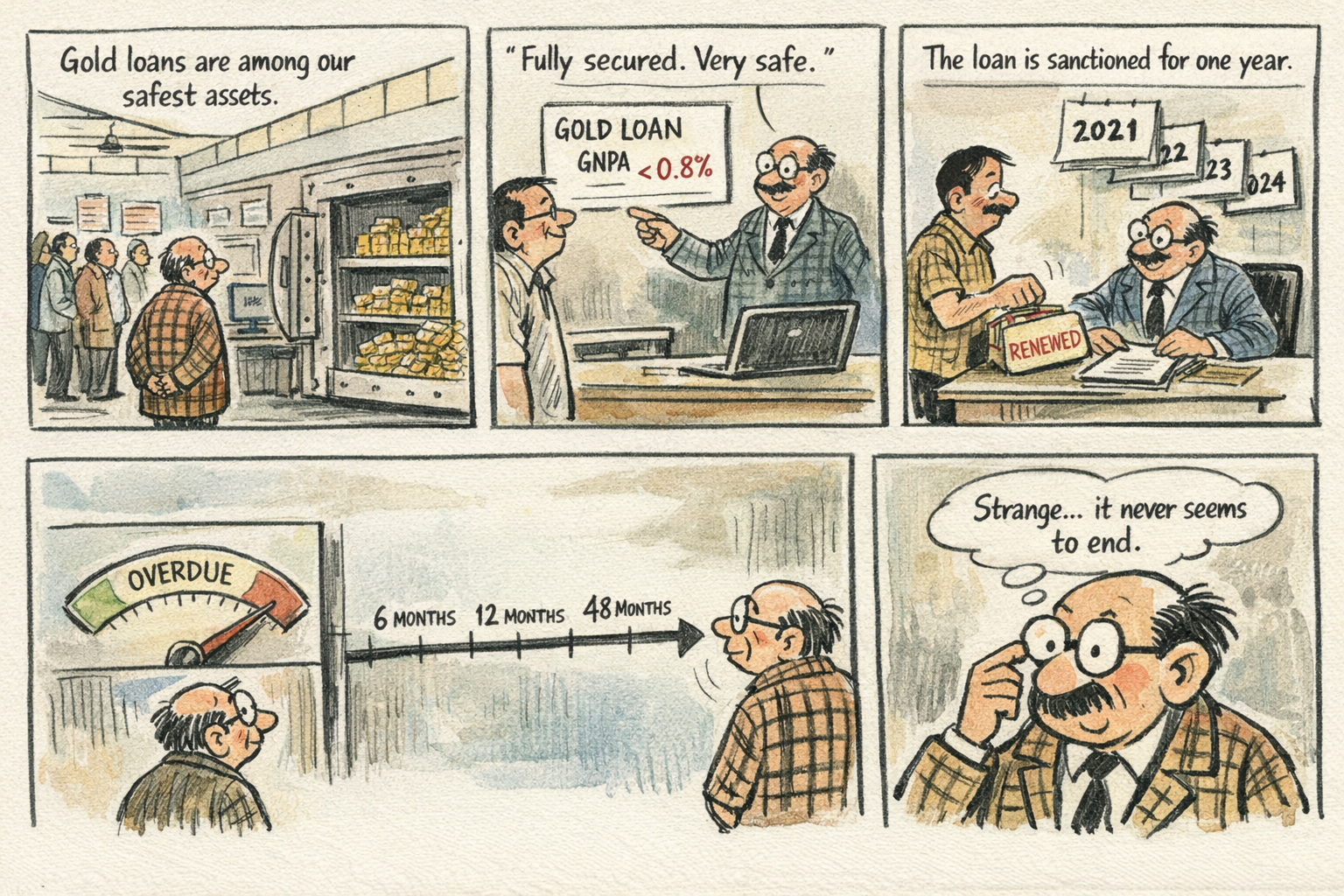
Gold Jewellery Business Lending – Episode 10 An Empirical Examination of Risk Through Bank and Borrower Behaviour Stories from the Balance Sheet: What gold loan portfolios reveal when you stop reading NPAs and start reading continuity. 1. Why Read Gold Lending from the Balance Sheet? Gold jewellery lending is often described as one of the safest forms of credit in Indian banking. Collateral is physical, liquid, and emotionally anchored. NPAs remain consistently low across cycles. Auctions are rare. Losses are infrequent. And yet, when one reads bank balance sheets over time , a different story emerges.
A cross bank categories—public sector banks, private sector banks, regional banks, small finance banks, and cooperative banks—gold loan portfolios share a striking pattern: Gold loan outstanding grows rapidly, GNPA remains stubbornly low, Exposure does not meaningfully run down, Renewals quietly replace closures. This episode reads gold jewellery lending not through delinquency ratios , but through balance-sheet continuity, persistence, and closure behaviour . 2.
System-Level Context: Growth Without Exit Across Indian banks, loans against gold jewellery typically constitute 2–10% of total advances , depending on institutional type. However, during gold price up-cycles, they contribute 15–35% of incremental retail credit growth , growing at 1. 5–2. 5× the pace of overall retail advances . Despite this acceleration: Gold GNPA remains below 1% across most banks, Compared with 2–4% in MSME portfolios and 3–6% in unsecured retail .
This convergence of low NPAs across heterogeneous institutions suggests that delinquency ratios lack discriminatory power in gold jewellery lending. 3. Public Sector Banks (PSBs): Scale Absorbs Risk Bank-wise balance-sheet snapshot (FY25) Bank Gold Loan Outstanding YoY Growth Gold GNPA Behavioural Signal State Bank of India ₹50,011 cr 53. 05% <0. 8% Large scale, renewal tolerance Indian Overseas Bank ₹69,188 cr ~45% <1% Predominantly agri-tagged Indian Bank ₹9,706 cr ~89% <0. 8% Rapid growth, continuity Bank of Baroda ₹7,076 cr ~56% <0.
8% Retail gold expansion Balance-sheet reading Gold loans form 3–6% of total advances and 8–12% of retail advances . Growth often exceeds 40–55% YoY in favourable price cycles. Auctions remain <1% of accounts . Effective exposure duration, inferred from continuity, extends to 24–48 months , despite contractual tenors of 6–12 months . Inference In PSBs, gold loan safety is achieved not through frequent exit, but through renewal tolerance and balance-sheet scale . Delinquency is suppressed; duration risk accumulates. 4.
Private Sector Banks: Discipline Visible in Churn Bank-wise snapshot Bank Gold Loan Outstanding YoY Growth Gold GNPA Behavioural Signal HDFC Bank ₹17,700 cr ~0. 6% <0. 5% Flat book, high closure ICICI Bank <₹20,000 cr (est.) 15–25% <0. 5% Controlled scaling Axis Bank <3% of advances 20–25% <0. 6% Closure-led churn Federal Bank 2–3% of advances 20–25% <0. 6% Shorter exposure life Balance-sheet reading Gold loans typically <3% of total advances . Growth aligned with retail ( 15–25% YoY ). Higher frequency of zero-outstanding events . Lower agri-tag penetration (<30%).
Inference Private banks do not appear safer because borrowers are better. They appear safer because closure discipline shortens exposure life , preventing perpetuity. 5. Regional / Gold-Centric Banks — When Gold Becomes a Balance-Sheet Anchor This category captures banks where gold jewellery lending is not a peripheral retail product, but a structural balance-sheet stabiliser .
The defining feature is not ownership, but behaviour : high continuity, low closure frequency, and long effective exposure duration. 5. 1 South Indian Bank — The Anchor Institution South Indian Bank provides the clearest evidence that gold-centric balance-sheet behaviour is not confined to policy-driven institutions . Despite being a private sector bank, its gold loan portfolio exhibits characteristics more commonly associated with regional and rural banking.
Balance-sheet observations (FY25, indicative): Gold loans outstanding: ~₹17,000 crore Gold loans as % of total advances: ~8–9% Agri-tag penetration: ~80%+ Gold GNPA: <1% Outstanding shows limited run-down across years Behavioural reading: Gold loans function as a recurring liquidity line , not a short-tenor bridge. High agri-tag penetration structurally lowers closure pressure. Renewals dominate maturities, extending effective exposure duration well beyond the contractual tenor. Risk does not manifest through delinquency, but through continuity .
Inference: In South Indian Bank, gold jewellery lending behaves like policy-softened working capital , not retail term credit. Risk is not visible in GNPA, but in exposure persistence . This makes South Indian Bank the natural anchor for the regional / gold-centric archetype. 5.
2 Other Regional / Old Private Banks — Variations on the Same Theme Banks such as Federal Bank and Karur Vysya Bank also carry meaningful gold portfolios, but with important differences: Lower agri-tag penetration than South Indian Bank Higher closure frequency Shorter effective exposure duration Inference: These banks demonstrate that closure discipline is a managerial choice , not a product inevitability. South Indian Bank’s behaviour is therefore not an industry default, but a deliberate balance-sheet posture . 5.
3 Regional Rural Banks (RRBs) — The Structural Extreme RRBs represent the most extreme form of gold-centric behaviour: Gold loans often constitute 6–10% of advances 70–90% agri-tagged , driven by PSL mandates Very low closure frequency Minimal auction incidence Gold GNPA consistently <1% Here, continuity is not discretionary—it is institutionally embedded . Inference: RRBs show what happens when renewal tolerance is mandated rather than chosen . They validate the same behavioural pattern seen in South Indian Bank, but in a purer, policy-driven form. 5.
4 Why South Indian Bank Matters More Than RRBs If only RRBs exhibited renewal-heavy gold portfolios, the phenomenon could be dismissed as a regulatory artefact. South Indian Bank removes that escape route. The presence of RRB-like gold-loan behaviour inside a private bank proves that perpetuity in gold lending is a balance-sheet strategy, not merely a policy distortion . Section 5 Synthesis Across regional and gold-centric banks: Gold loans rarely default, But they also rarely close, Exposure duration silently lengthens, And risk migrates from credit quality to lifecycle governance .
This is not fragility. It is misread stability . 6. Small Finance Banks (SFBs): The Shock Absorber Representative SFB behaviour Bank Gold Loans (% of Advances) Stress-Period Change Gold GNPA Behavioural Signal AU SFB 5–7% +2–3% <1% Counter-cyclical scaling Ujjivan SFB 5–7% +2% <1% Duration build-up Equitas SFB 5–8% +2% <1% Renewal intensity rises Balance-sheet reading Gold exposure rises when microfinance/unsecured stress appears. Outstanding remains stable despite scheduled maturities. Exposure vintage increases (>24 months inferred). Inference Gold loans act as portfolio stabilisers .
Repeated use converts insurance into latent duration risk . 7. Cooperative Banks: Governance Decides Outcomes Institution Type Gold Loans (% of Book) Gold GNPA Dispersion Urban Cooperative Banks 10–20% <1% Very high District Central Co-ops 12–25% <1% Very high Balance-sheet reading Same product, same collateral. Some co-ops show declining outstanding (closures). Others show unchanged balances year after year. Inference In cooperative banks, gold lending is not a credit test—it is a governance test . 8.
Why GNPA Converges Across Archetypes Across all bank types: Collateral possession ≈ 100%, Auction timelines are operational (30–90 days), Interest servicing exceeds 95%. These features suppress GNPA formation , causing apparent safety. GNPA is therefore an outcome metric, not a risk-discriminating metric in gold jewellery lending. 9.
The Dominant Risk Variable: Exposure Duration The most revealing metric is: Time Since Last Zero Outstanding (TSZO) Portfolio Type TSZO Distribution Risk Interpretation Closure-disciplined >70% <12 months Self-liquidation proven Renewal-heavy 40–60% >36 months Conditional liquidity Perpetual TSZO never zero Price-dependent exposure TSZO is binary, auditable, and behavioural . 10.
Behavioural Signal Decoder Signal Meaning Inference High renewals Exit deferred Duration risk builds Low auctions Stress avoided Risk surfaces suddenly Stable outstanding Renewals offset maturity False comfort High agri-tag Policy perpetuity Structural risk Rising vintage Ageing exposure Severity risk 11. Loss: Rare, Deferred, Non-Linear Loss in gold jewellery lending is not frequent , but it is real . It occurs when: Long exposure duration, Delayed exit, Price or governance shock, coincide. Gold loan risk is therefore severity-driven, not frequency-driven . 12.
The Central Inference In gold jewellery lending, risk is not whether a loan defaults, but whether it ever closes. Until closure occurs, self-liquidation remains an assumption—not an observed fact. This does not argue that gold loans are unsafe. It argues that they are easy to misread . Final Note This episode does not predict loss. It restores measurement discipline . Because in banking, what is not measured eventually surprises.
The Balance Sheet as the Truth Serum When we move from product notes and CAMs to actual bank balance sheets , five things become immediately visible: Gold loan outstanding grows faster than retail credit Gold GNPA remains stubbornly low Gold exposure does not materially run down Renewals quietly replace closures Exposure age is not disclosed—but implied This pattern holds across: Public Sector Banks Private Sector Banks Regional Rural Banks Small Finance Banks Cooperative Banks The conclusion is unavoidable: Gold loans are not failing. They are persisting. Persistence is not a credit outcome.
It is a behavioural outcome . Why Persistence Matters More Than Performance In most lending products, time works against the bank: Inventory ages, Receivables dilute, Projects stall, Cash flows weaken. In gold lending, time appears neutral —sometimes even helpful—because: Gold prices often rise, Collateral value refreshes, Interest gets serviced, Renewals reset the clock.
But this neutrality is deceptive. Time does not reduce risk in gold lending. It concentrates it . Every renewal without closure: Extends exposure duration, Defers exit testing, Increases dependence on price, Weakens the informational value of GNPA. The CC Account Fallacy (Why the Comparison Fails) A frequent defence is: “We renew CC limits every year as well. Gold is even safer.”
The comparison is intuitive—but flawed. A CC account: Tests itself daily through cash flows, Signals stress gradually, Forces action through erosion, DP mismatch, turnover decline. A gold loan: Produces no endogenous stress signals , Shows stability until closure is forced, Converts all risk into a single binary event . So while both renew: CC risk is continuously revealed , Gold risk is continuously deferred . That difference is everything.
The central inference of this episode is therefore unambiguous: In gold jewellery lending, risk is not whether a loan defaults, but whether it ever closes. Until closure occurs, self-liquidation remains an assumption rather than an observed outcome. This episode does not argue that gold jewellery lending is unsafe. It argues that it is easy to misread . Balance-sheet stability, in the absence of closure discipline, reflects deferred testing rather than proven resilience .
Archive note
This essay was restored from Vivek Krishnan’s Wix journal. Its original wording and available visuals have been preserved.
This page is now the permanent canonical edition within Vivek Perspective.