Policy Vs Practice Series
Introduction
When RBI first introduced co-lending, the promise was simple — leverage the NBFC’s reach with the bank’s cost of funds. Two models emerged:
Mode 1: Bank and NBFC co-lend from day one.
Mode 2: NBFC originates, books the loan, then transfers the agreed share to the bank after a short period.
For years, Mode 2 was the operational workhorse — flexible, adaptable, and a perfect fit for products where disbursements happened in stages or where bank readiness lagged behind origination.
On August 6, 2025, a single line in RBI’s revised guidelines changed the game:
“The bank’s share in loans under co-lending must be booked within 15 days of the first disbursement to the borrower.”
Why This Matters
The 15-day cap is not just a compliance checkbox — it’s a structural kill-switch for many Mode 2 use cases.
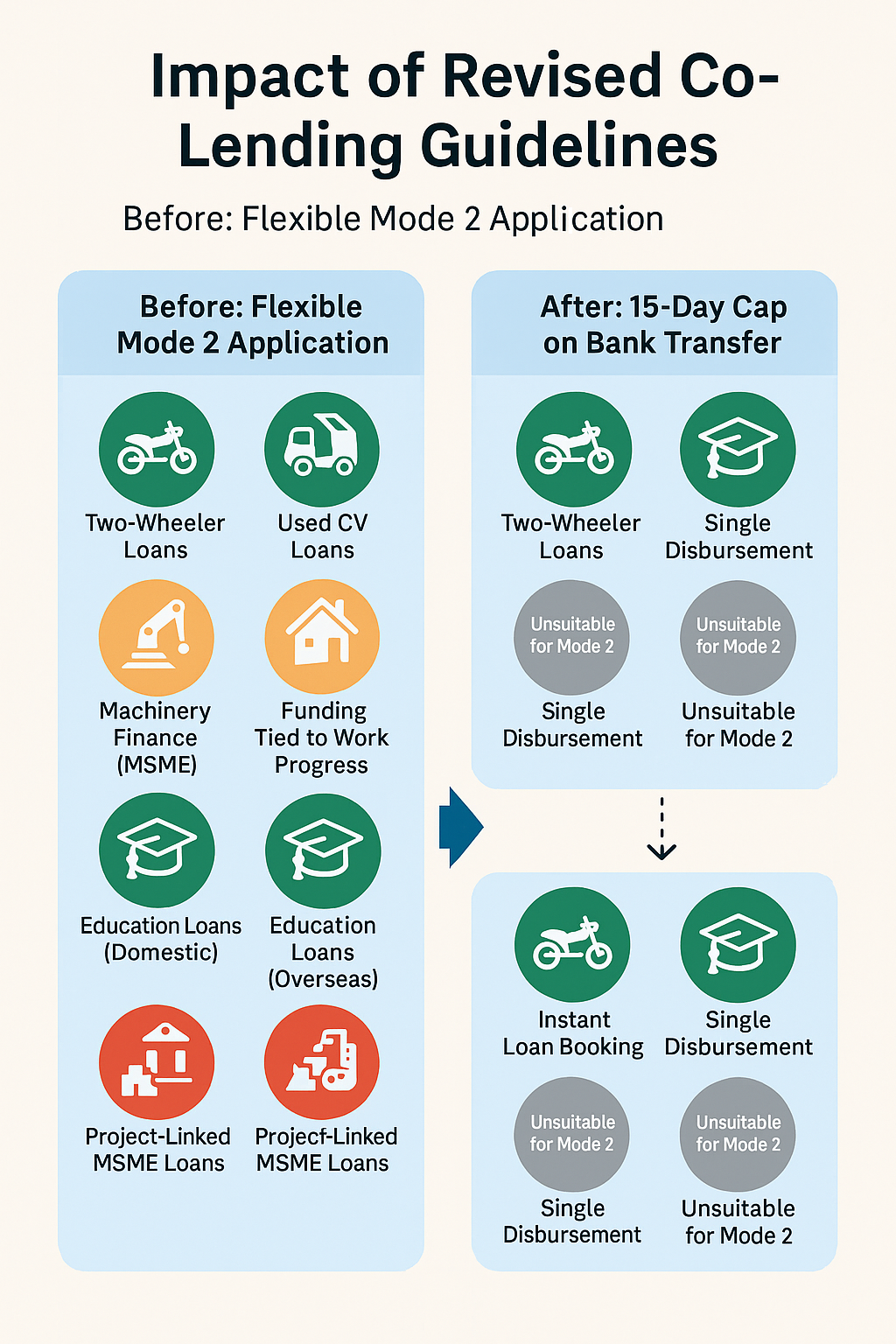
The Mode 2 Viability Map (Post-Aug 6, 2025)
Product Category | Typical Disbursement Pattern | Transfer to Bank Feasibility (≤15 Days) | Mode 2 Viability | Reason for Impact |
Two-Wheeler Loans | Single-day, low-TAT | ✅ Yes | High | Quick disbursal; easy to meet transfer deadline. |
Used CV Loans | 7–20 days incl. valuation & RTO | ⚠ Partial | Moderate | RTO delays may breach 15-day limit. |
Machinery Finance (MSME) | Stage-wise release | ❌ No | Low | Instalment-linked disbursements exceed 15 days. |
Home Improvement Loans | Staggered based on work completion | ❌ No | Low | Cannot transfer partial disbursements under Mode 2 structure. |
Education Loans (Domestic) | Single release | ✅ Yes | High | Works if release is immediate; not for instalment disbursals. |
Education Loans (Overseas) | Tranches aligned to semesters | ❌ No | Low | Semester gap kills transfer window. |
Agri Equipment Loans | Linked to delivery from dealer | ⚠ Partial | Moderate | Seasonal delivery delays can push beyond limit. |
Project-Linked MSME Term Loans | Milestone-based | ❌ No | Low | Almost all breach 15-day cap. |
Working Capital Term Loans (WCTL) | Single release | ✅ Yes | High | If sanctioned amount is released at once. |
Invoice Discounting | Single-day post acceptance | ✅ Yes | High | Fits perfectly with Mode 2 timelines. |
Sector-Level Impact
Agri Machinery Finance
Before: NBFC could book the loan when farmer placed order, wait for delivery (often weeks later), then transfer share to bank.
Now: Delay in delivery breaches 15-day window → bank participation drops → NBFC funds the entire loan or shifts to Mode 1.
Project-Linked MSME Loans
Before: Funds released in phases after site inspection. Transfer to bank possible after first milestone.
Now: Milestone gap > 15 days kills Mode 2 feasibility → Mode 1 becomes default, even if bank risk appetite is lower in early stages.
Policy vs Practice: The Gap
Policy intent: Faster booking, cleaner risk-sharing, reduced warehousing risk for NBFCs.
Practical outcome: Entire product lines in NBFC portfolios lose Mode 2 viability.
Unintended consequence: Push towards Mode 1 in products where banks historically had low appetite at origination stage.
Where Do We Go From Here?
For NBFCs: Re-engineer disbursement processes to fit the 15-day cap or redesign products for Mode 1.
For Banks: Build faster credit ops for milestone/staggered products or risk losing co-lending share.
For Regulators: Consider sector-specific relaxations where staged disbursements are inherent to the product.
Conclusion
Mode 2 was never just a loophole — it was a bridge between NBFC agility and bank prudence. The August 2025 directive doesn’t just change timelines — it changes the feasibility of co-lending for entire sectors.
If policy and practice don’t converge, we risk losing the very diversity in co-lending products that the framework was meant to foster.
Archive note
This essay was restored from Vivek Krishnan’s Wix journal. Its original wording and available visuals have been preserved.
This page is now the permanent canonical edition within Vivek Perspective.