A recent chance meeting at an Agri University, led a group of us discussing very broadly on the systems orientation / adapting of an algorithm based approach in Agri Business Management. It was very interesting to note , of trends, where in many farmers used technology to book maximum gains for any given day.
This ushered in the question of the day - " Can we use an algorithmic approach to finance agri-related customers ? "... A Debate ensued !
The Key Challenges that would need to be contemplated while deciding on an algorithmic approach :
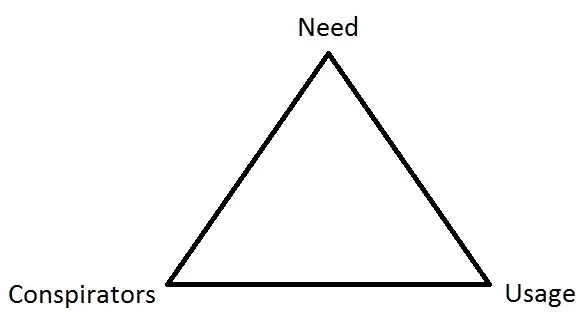

- How do we judge Agri Business Customers ?
- How is an Finance Company Risk Quotient translated into Metrics ?
- Further, how do we look at metricizing the Risk Appetite of the company. Table of Tolerances ?
- A defined assessment process consisting of - Field Investigation, Market Assessment, Reference / Neighbour check, Validation of information, Tabulation and Documentation, Customer validation, Rating and Product Offering, Policy and Underwriting, Compliance and Regulatory checks, Regulation and administration, mode of operation, repayment management and of course collections. All of this will need to be fit into the system.
- Does the current day Agri Customer genuinely depend on Crop Income ? About 70% of the country's Agri is patterned with Paddy as the key crop. How many of us are aware that an average earning from an acre of paddy is between Rs. 10000 - Rs. 13000/ - per acre per cycle. So with an annual average income of Rs. 25000/- per acre, and the typical 4 acre norm - Are we looking to fund the customer with an average annual income of Rs. 1 Lakh ? He would certainly be eligible for a KCC / SHG / JLG / MFI product. What about the asset based or the term loans ? So, is the traditional crop income / land holding truly a assessment metric ?
- There are states like Madhya Pradesh, Telangana, and Gujarat, where even many instances of less than one acre being given half yearly repayment tenure by financial institutions and banks. We speak of the "Counter-Intuitive" patterns, which are more like strategic ploys by financial institutions to gain a back door entry into the market. Their NPA experiences do not show of a sensitivity based approach.

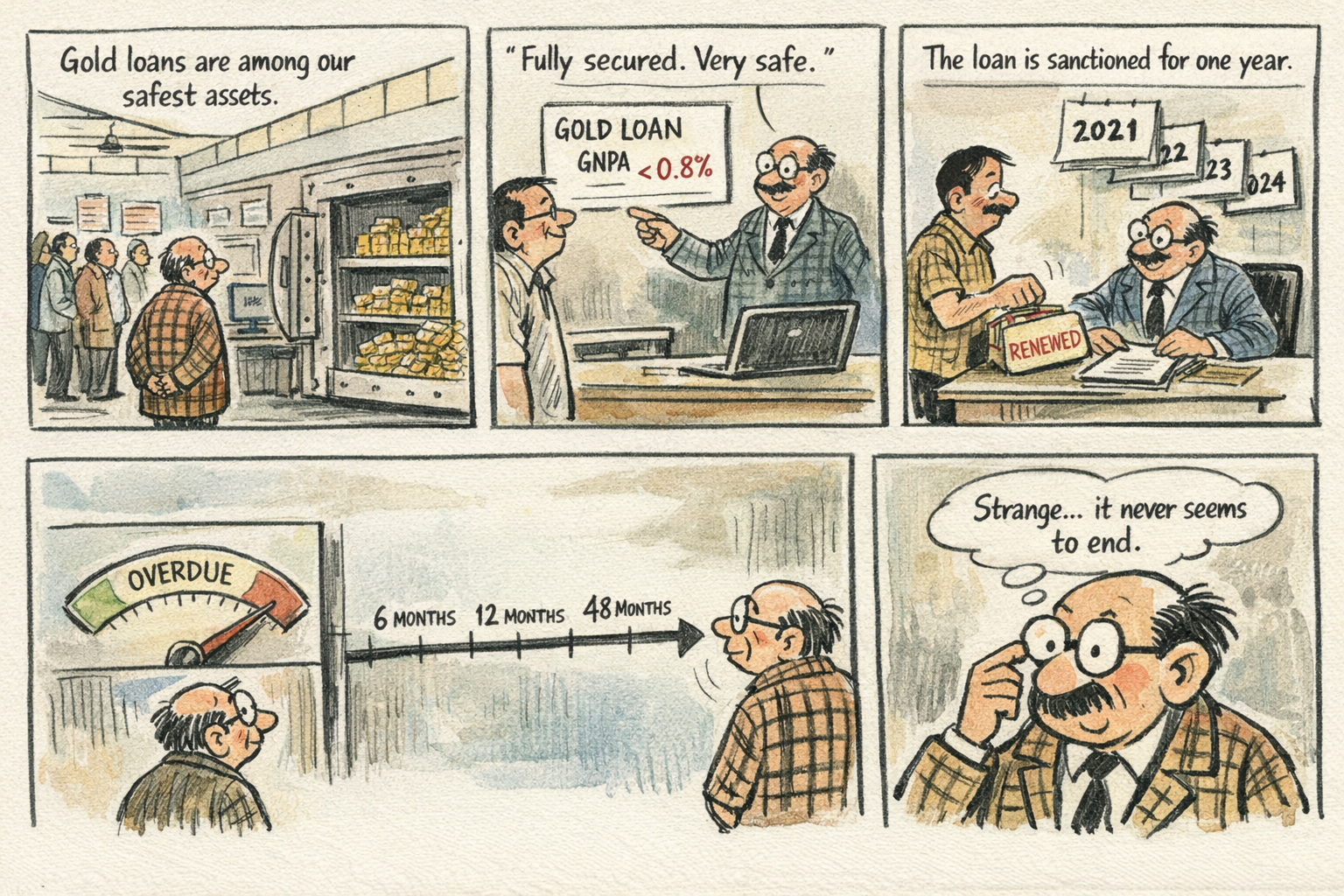
So how do they work on NPAs ? Reduce the pace of occurrence and increase the overall number of cases to more than 5 times. To explain this with an example – customers are offered half yearly repayments irrespective of their background / profile / need. So the case will take a minimum of 9 months to show itself up as NPA, or at least 7 months if the financier is prudent. Let us say we have sourced 100 cases in month 1, all of which will have their first installment due in month 6. If the NPA to stock has to remain small the stock size by month 6 should be 600 units. This ratio is maintained. Not all 100 cases sourced in month 1 goes bad, only about 20 do. But a larger denominator masks the effects.
- Data Dimensions - Many a time, many algorithms have 2 dimensional data. Like for example, irrigation,

Dimension 1 - Water Irrigation Sources available in the Geography / Location,
Dimension 2 – Water Irrigation facility available at the Customer’s place
The Missing Dimension
Dimension 3 - Water Irrigation source Year-wise for the last 5 years
Inclusion of the third dimension only makes the data truly valuable. It toes along the broad Rural Financing Tenet / Guideline : “ As long as the earning capacity of the rural customer is sustained and profitable, repayments will never require follow-up ”. The algorithm needs to be predictive and hence requires 3 dimensional information to be captured. How do we capture this ?
8. Red Flags - These are based on
(a) Cases / Patterns highlighted by the IAD / RCU / Fraud Prevention Team, which will highlight types of cases that we may not want to get into.
(b) Our own experiences / Loss experiences with specific brands or models
(c) Location / Geo tagging, for profile or model types and risk types
(d) Risk Appetite defined by the management / policy, with exceptions or tighter norms for specific states / locations
The system needs to provide an auto – alert at the point of entry itself. The dynamic nature of this variable poses a challenge.
--------*****----------

All in all, it brought in a higher regard for the human eye which is capturing all of this, the human brain which is assimilating this as input and providing a summarized output in form a decision.
In attempting to build an algorithm, we are wanting to convert every perception of feel, sense, touch, sight into data points, for a machine to map a statistical pattern based on past experiences.
Yet, the marketing / strategic side of me, still believes that machine needs to be a record keeper to provide us the inputs and the risk levels needs to be judged on the intuitive assessment of having seen the customer in person. An Algorithmic approach can be adopted to process faster, but not to substitute human judgment.
Archive note
This essay was restored from Vivek Krishnan’s LinkedIn archive. Its original wording and available visuals have been preserved.
This page is now the permanent canonical edition within Vivek Perspective.