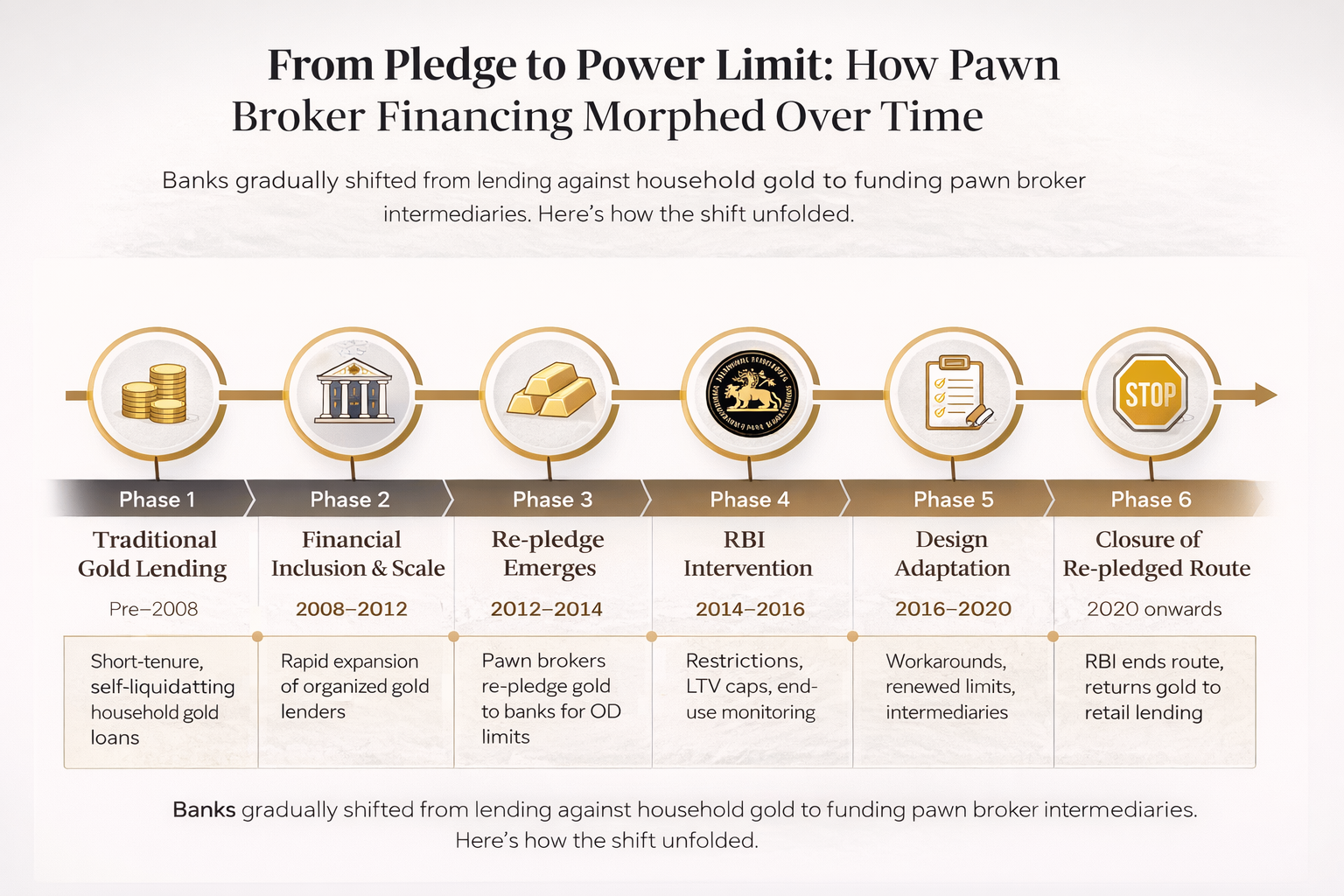
When Gold Became Working Capital: The Rise and Closure of the Re-Pledged Route Gold Jewellery Business - Episode 15 Introduction For decades, pawn brokers occupied a quiet but critical space in India’s gold ecosystem — bridging household distress, informal credit demand, and last-mile liquidity. Banks, in turn, saw them as efficient conduits: asset-backed, cash-generative, and seemingly low risk. Over time, however, something fundamental changed. Gold stopped behaving like a self-liquidating retail collateral and began functioning like working capital .
What was once a short-tenure household loan increasingly morphed into revolving overdrafts, power limits, and re-pledged structures routed through pawn brokers and intermediaries. The balance sheets looked healthy. NPAs stayed benign. Yet the lifecycle of gold credit quietly broke. This episode examines how and why pawn broker financing rose sharply across bank portfolios — and why the regulator eventually stepped in to shut the re-pledged route altogether .
Not through conjecture or isolated incidents, but by reading the signals embedded in balance sheets, product structures, renewal behaviour, and regional clustering. This is not a story about credit failure. It is a story about design drift — where collateral comfort masked structural risk, and where form slowly overrode substance. Pawn Broker - The Financing pattern - How it emerged Why Did RBI Ultimately Close the Re-Pledged Route? Short answer: Because design fixes could not cure a structural problem .
The re-pledged route failed not due to lack of rules , but because it violated the economic intent of gold lending itself . 1. What RBI Originally Tolerated Pawn Broker Funding (and Why) RBI was not ideologically opposed to gold-backed credit. What it historically permitted: Retail gold loans Against household jewellery Short tenure Self-liquidating With clear borrower identity And direct possession of gold by the lender This worked because: Credit risk was limited Price volatility was manageable End-use was consumption smoothing, not leverage The system unwound naturally 2.
What the Re-Pledged Route Changed (Quietly) The re-pledged model altered four fundamentals at once : (a) Borrower Identity Shifted From households ➝ pawn brokers / intermediaries (b) Purpose Shifted From emergency liquidity ➝ working capital / arbitrage (c) Tenor Shifted From short, self-liquidating ➝ rolling OD / evergreen limits (d) Control Shifted Gold custody became multi-layered Same gold backed multiple balance sheets At this point, gold was no longer collateral . It became credit-creating inventory . 3.
Why Design Tweaks Didn’t Work RBI tried incremental controls , not an outright ban: ✔️ LTV caps ✔️ End-use declarations ✔️ Audit & stock statements ✔️ Shorter review cycles ✔️ Classification tweaks But all of these failed because: Form was controlled. Substance was not. 4.
The Core Regulatory Failure: Fungibility Once gold entered a re-pledge loop: It funded multiple borrowers Across multiple tenors With no natural amortisation And opaque custody chains Even with perfect documentation: Price shocks multiplied losses Enforcement became legally complex Systemic exposure grew silently RBI could not observe risk in real time . That is unacceptable for a monetary regulator. 5.
Why “Better Design” Wasn’t Enough This is the key insight : Some products cannot be made safe through design because their incentives are misaligned. In re-pledged gold: Banks earned low-risk yields Pawn brokers earned leverage Borrowers saw easy liquidity But system risk accumulated invisibly No LTV or audit rule could fix that. 6. The Macro Overlay (Often Missed) RBI also saw macro spillovers : Artificial demand for gold Pressure on imports & CAD Credit creation linked to a volatile commodity Parallel shadow-bank style leverage inside banks This crossed from prudential risk into macro-financial stability .
That’s where RBI draws a hard line. 7. Why Closure Was the Only Logical Endgame By 2020, RBI faced a choice: Option A: Keep patching a structurally flawed route Option B: Restore gold lending to its original economic role It chose Option B . Lessons from the Entire Cycle 1) The Empirical Question A persistent feature of Indian bank balance sheets puzzled supervisors: Why were gold-backed portfolios growing rapidly, remaining perpetually current, yet rarely closing?
This was not a credit quality mystery. It was a portfolio behaviour anomaly . In a truly retail gold book, churn is natural. Borrowers pledge, repay, close, and re-enter when needed. The portfolio “breathes.” But here the book didn’t breathe — it compounded . That is what changed the supervisory lens from “performance” to “behaviour.”
Bank Archetype Gold Loans as % of Advances Avg Ticket Size Signal OD / CC Usage Renewal Intensity Closure Frequency Inference Public Sector Banks 3–6% Medium → High Moderate–High High Low Early intermediary absorption Private Sector Banks <3% Low–Medium Low Moderate High Retail-dominant discipline Regional / Old Pvt Banks 6–10%+ High dispersion High Very High Very Low Core re-pledge exposure Small Finance Banks 5–8% Medium Rising Rising Moderate Inherited risk Cooperative Banks 10%+ (often) High Very High Persistent Minimal Governance-driven exposure 2) What Balance Sheets Did Not Say Explicitly No annual report disclosed line items such as: “Loans to pawn brokers” “Re-pledged gold exposure” “Intermediary gold OD” But across bank archetypes, certain signatures repeated : Rising ticket sizes OD-heavy structures Renewal persistence (limits rolling year after year) Regional clustering (specific belts showing disproportionate growth) These are not retail gold loan signatures.
Retail gold lending is granular and widely distributed. Intermediary-driven books cluster where intermediary ecosystems are dense — jeweller markets, pawn belts, bullion lanes, traditional pledge economies. Balance sheets may not “name” the exposure. But their behaviour betrays the structure .
Dimension Retail Gold Loans Gold-Backed OD / Re-Pledge Borrower Household Pawn broker / trader Typical Ticket Size ₹50k – ₹3L ₹10L – ₹1Cr+ Tenor 6–12 months Revolving Closure Frequent Rare Renewal Conditional Automatic GNPA Behaviour True performance Suppressed Collateral Exit Physical Deferred 3) How Gold Quietly Became OD Power Gold migrated from: a household liquidity instrument to an intermediary balance-sheet stabiliser That shift matters.
When a household pledges jewellery, the loan is typically: small ticket short tenor need-driven self-liquidating But an intermediary OD behaves differently: permanent liquidity minimal principal repayment renewal becomes the norm comfort comes from over-collateralisation , not cash flows This is how a self-liquidating collateral product morphs into evergreen credit . Gold stops being “emergency money. ”It becomes “OD power.”
Observable Signal Why It Matters Regulatory Interpretation Rising avg ticket size Households capped Intermediary borrowers OD growth > MSME turnover WC mismatch Balance-sheet parking Low GNPA + high vintage Risk deferred Renewal masking Regional clustering Not population-driven Pawn/bullion hubs Minimal closures No lifecycle end Evergreen credit 4) Why GNPA Metrics Failed Completely This is the part most bankers miss: GNPA is a poor detector of structural gold risk.
Gold-backed OD rarely defaults in the conventional sense because: gold prices often rise over long periods, giving comfort renewals suppress delinquency liquidation is discretionary (and reputationally sensitive) the account can be kept “regular” via periodic interest servicing So GNPA converges to sub-1% across banks and appears “best-in-class.” But that is precisely the problem: A book can be technically performing while being structurally unhealthy .
What GNPA failed to capture was not loss. It failed to capture absence of closure . Metric Expected Risk Signal Actual Outcome Why It Failed GNPA % Should rise Stayed <1% Renewals suppress delinquency SMA trends Should appear Rare OD flexibility Recovery stress Expected Minimal Over-collateralisation Litigation Expected Delayed Disputes arise at exit 5) What RBI Read Differently RBI did not ask: “Is this loan performing?” It asked: “Why is this loan never ending?”
This is a very different question. Because when a gold-backed exposure becomes perpetually renewing, supervision starts seeing risk in places GNPA does not touch: the same gold supporting multiple exposures ownership becoming ambiguous across layers custody chains weakening enforcement inviting litigation and conduct scrutiny incentive misalignment: renewal replaces resolution In other words, RBI began treating it as: governance risk, not credit risk.
Option Available Why RBI Rejected It Tighten LTV Doesn’t fix ownership Cap exposure Doesn’t stop layering Higher provisioning Loss not the issue More disclosure Too late Ban re-pledge Fixes root cause 6) The Regulatory Response: Eliminate the Structure This is where the regulator’s philosophy becomes clear: Instead of tightening ratios endlessly, RBI removed the pathway. Loans against re-pledged gold were prohibited.
This single move: collapsed intermediary leverage restored the single-owner collateral principle prevented credit multiplication on static assets forced gold lending back into observable, controllable forms In many regulatory interventions, the trick is not to police behaviour forever —it is to remove the architecture that makes risky behaviour profitable . That is what happened here. 7) Why This Was a Systemic Reset RBI’s intervention was not tactical. It was architectural.
It re-anchored gold lending to fundamentals: household ownership clear custody clear borrower identity visible lifecycle closure The deeper message was not merely “don’t re-pledge.” The message was: Gold lending must remain self-liquidating, observable, and single-layered. Once layering begins, supervision loses visibility — and visibility is the regulator’s oxygen. 8) The Lesson for Bankers Gold loans do not always fail because of default. They fail when renewal replaces resolution .
A collateralised book can look safe for years while silently becoming: evergreen by design dependent on continued price comfort structurally unable to unwind without pain The re-pledge ban is a reminder: Collateral safety without lifecycle discipline is an illusion. 9) Summary The re-pledged route was not closed because gold became risky —it was closed because credit forgot how to end .
Archive note
This essay was restored from Vivek Krishnan’s Wix journal. Its original wording and available visuals have been preserved.
This page is now the permanent canonical edition within Vivek Perspective.