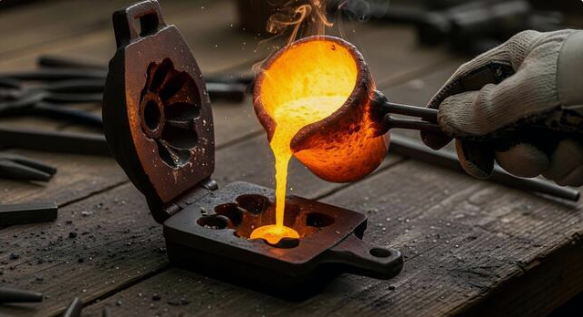
Jewellery Business Series — Episode 1 A story of fire, skill, memory… and money . If you walk into a jewellery workshop before sunrise, you will hear it before you see it. The hiss of the furnace. The metallic tap of a hammer. The whir of a rolling mill waking up for the day. On the table lies a simple 24K gold bar —no shine, no personality, no beauty. Just a piece of metal.
But in the next few hours, it will become something else entirely. 1. The First Transformation — Fire & Purity The bar is melted, purified, and alloyed. Gold is too soft to hold shape, so copper and silver enter the story. This single choice—21K or 22K or 18K—decides what the ornament can become. Even at this early stage, a jeweller is already calculating: Wastage Karat variation Recovery cost Labour needed Final margin The business starts long before beauty appears. Gold Bar - Transformation 2.
The Metal Splits Into Many Futures ✨ The Ingot: Where All Journeys Begin Once alloyed, the molten gold settles…The glow fades…And a dull, heavy ingot emerges — quiet, unassuming, yet full of destiny.
From this single block, paths diverge : Some ingots become bangles — requiring ductility Some become chains — needing tensile strength Some become pendants — where design & stone-setting dominate Some become filigree — requiring extreme softness and precision Some become plain-gold inventory — the banker’s favourite Some become stone-heavy designs — the auditor’s nightmare Every ornament belongs to a family , a bucket , a behaviour pattern . 💠 Bankers rarely see this. 💠 Karigars never forget it.
Because the way an ingot will behave in melting, rolling, drawing, casting, stone-setting, polishing……is already decided inside that alloy . And for lenders, this matters: Collateral quality doesn’t begin at the showcase — it begins in the crucible. 3. The Karigar’s Touch: Where Metal Learns to Become Art This is where the real magic begins — far from the glitter of the showroom and deeper than any stock statement can capture. Here, in a modest workshop with a single bright lamp, gold is not yet ornament. It is a living metal being coaxed, persuaded, and disciplined into beauty.
Gold is beaten until it learns strength. Rolled until it yields uniformity. Stretched until elasticity meets its limit. Twisted until the design breathes. Soldered until joints become invisible. Engraved until personality emerges. Polished until the surface remembers light. And through every step, the karigar reads the metal like a language.
He knows, without needing a single instrument: Which alloy will crack when pushed a fraction too far Which sheet will tear under the rolling mill because the mix was imperfect Which wire will break during twisting because the ductility was misjudged Which design will hold stones securely and which will betray the setter Which piece will shine after polishing and which will stubbornly stay dull Which ornament will melt cleanly and return purity without surprises Which stock will confuse a banker , because its weight and true value do not live in the same place This wisdom cannot be taught in classrooms.
It lives in the fingertips that have shaped gold for decades. It grows in the rhythmic blow of the hammer, the controlled hiss of the flame, the way the karigar tilts his head to judge colour, depth, hardness, and possibility. Bankers rarely see this . Karigars never forget it. And somewhere between these two worlds — between the artisan who understands metal and the financier who understands numbers —lies the truth about jewellery lending. A truth that begins not in the balance sheet, but in the workshop where metal learns to become art .
📘 Banker’s Classification Table of Ornament Families (Gold Bar to Ornament) How Different Gold Pieces Behave as Inventory, Collateral, and Risk Gold Bar / Classification © Vivek Krishnan | The Vivek Perspective | 2025 Ornament Family PSU Banks Private Banks Regional Banks SFBs Cooperative Banks 1. Plain Gold (22K) ✔️ High ✔️ High ✔️ Very High ⚠️ Moderate ✔️ Very High (sometimes too high) 2. Casting / Hollow Jewellery ⚠️ Caution ⚠️ Very Cautious ⚠️ Mixed ⚠️ Low ⚠️/❌ Often overvalued 3. Stone-Studded (CZ / Kundan / Diamond) ❌ Accept gold weight only ❌ Strict ⚠️ Partial ❌ Reject ⚠️/❌ Often mis-funded 4.
Antique / Temple Jewellery ❌ Avoid ❌ Avoid ⚠️ Cautious ❌ Reject ⚠️ Emotional overvaluation 5. Filigree (Fine Work) ❌ Avoid ❌ Avoid ⚠️ Limited ❌ Reject ⚠️ Risky 6. Bridal Heavy Sets ⚠️ Accept gold only ⚠️ Strict ✔️ Accept more due to local market ⚠️/❌ Low ⚠️/❌ Often over-valued 7. Lightweight (18K/20K) ⚠️ Purity check needed ⚠️ Low comfort ⚠️ Familiarity helps ❌ Rarely accept ⚠️ Often overvalued 8. Coins & Bars ✔️ Best ✔️ Best ✔️ Best ✔️ Best ✔️ Best 9. Custom/MTO Pieces ❌ Avoid ❌ Avoid ⚠️ Accept limited ❌ Reject ⚠️ Often accepted (risky) 10.
Old Gold / Exchange Stock ⚠️/❌ Reject ❌ Reject ⚠️ Partial ❌ Reject ⚠️ Accept (dangerous) 11. Principal Gold (Job-Work Gold) ⛔ Exclude ⛔ Exclude ⛔ Exclude ⛔ Exclude ⚠️ Sometimes wrongly included © Vivek Krishnan | The Vivek Perspective | 2025 🔍 What this table helps a banker see Not all “jewellery stock” behaves like gold. Some categories behave like bullion → ideal for collateral. Some categories behave like fashion inventory → worthless for collateral. Some categories belong to someone else (principal gold) → should be fully eliminated from stock statements.
This is where the banker–karigar gap becomes clear: Karigars know which items melt cleanly, crack easily, retain weight, or lose wastage. Bankers often treat all stock as equal grams — a dangerous assumption. ❌ The “Conversion Ratio Margin” Myth — And Why It Has Zero Value In wholesale jewellery and job-work business models, it is common to hear: “Sir, we keep 4–6% of gold during conversion. That retained gold is our equity , our margin .” It sounds attractive. It even sounds logical.
But for a banker, this has no value . Here’s why. 🔍 1. It is not equity. It is merely unreturned principal gold When a wholesaler or principal gives 1 kg of gold to a job-worker, and the job-worker returns 950–960 grams after manufacturing: The missing 40–50 grams is claimed as “retained gold” The business team pitches this as “margin” or “skin in the game” But in reality: This is not money the borrower has invested.
This is gold the principal has lost or allowed due to process wastage. It is not promoter contribution . It is not collateral . It is not equity . It is simply process shrinkage . 🔍 2. The retained grams are already “priced in” — not an extra buffer Wholesalers build wastage into: making charges purity margins design premiums merchant commissions Meaning: the margin is embedded in the transaction , not in the borrower’s balance sheet. There is nothing extra available to form “equity”. 🔍 3.
This gold is not owned by the job-worker Ownership is the key principle in credit. The job-worker does not: pay cash for this gold take price risk have the right to liquidate it independently If a jeweller cannot sell that retained gold without violating the principal–worker relationship, it is not his collateral. Ownership ≠ possession. Bankers must recognise this difference. 🔍 4.
In most audits, this “margin” cannot be traced Ask any auditor or stock verifier: Where is this “retained” gold recorded? In which ledger does it sit? Under what heading? Is purity verified? Answer: It is never clearly documented. Because it is not a real asset. It is an accounting assumption framed by the industry. 🔍 5. It creates a dangerous illusion of comfort for lenders When business teams pitch: “Sir, borrower has 4–6% natural margin; GML is safe.”
…they forget that this “margin”: Is not cash Is not bankable Does not cover price volatility Cannot repay interest Cannot be pledged Does not show up in net worth So in stress situations, this margin evaporates first…and the GML gap widens fastest. 🚨 The Banker’s Bottom Line Process wastage is NOT equity. Retained gold is NOT promoter margin. Job-work leftover grams are NOT collateral. Any lending structure that assumes this “conversion margin” is a buffer is fundamentally flawed.
If GML goes wrong, this so-called buffer: cannot be seized cannot be melted cannot be auctioned cannot be valued cannot be enforced legally It simply does not exist. 4. The Ornament Takes Life From this point onward, gold stops being metal and becomes emotion: A chain for a birthday A bangle for a wedding A necklace for a festival A pair of studs for a child’s first gift At every stage, value changes: Metal value Labour value Design value Stone value (if any) Sentimental value And these values behave differently in a banker’s world. Some ornaments melt beautifully into pure gold. Some lose too much in wastage.
Some are impossible to value without dismantling. Some contain gold that does not belong to the jeweller (principal gold). Some have stones worth nothing in liquidation. This is why stock statements lie , unless the banker understands the journey. 🌟 Why This Journey Matters to a Banker Because every gold loan, every CC limit, every WCTL, every GML, and every takeover proposal is built on one assumption: “The gold shown in the stock actually exists and behaves predictably.”
But gold never behaves uniformly . Its behaviour depends on: Purity Manufacturing method Ornament family Labour intensity Stone content Melt loss Whether the gold actually belongs to the borrower Understanding the journey of a gold bar is the only way to understand: Collateral risk GML stress Conversion myths Wastage manipulation Stock overstatement Bullion vs ornament behaviour A banker who knows how gold travels will never be misled by how gold appears.
📘 Unified Banker Table: Ornament Family vs Bank Type Funding Comfort Legend: ✔️ High Comfort | ⚠️ Caution | ❌ Avoid | ⛔ Exclude Entirely 🔶 MASTER TABLE — One View, All Banks Ornament Family PSU Banks Private Banks Regional Banks SFBs Cooperative Banks Banker Interpretation 1. Plain Gold (22K) ✔️ High ✔️ High ✔️ Very High ⚠️ Moderate ✔️ Very High (sometimes too high) Best collateral; behaves like bullion 2. Casting / Hollow Jewellery ⚠️ Caution ⚠️ Very Cautious ⚠️ Mixed ⚠️ Low ⚠️/❌ Often overvalued Hollow = unpredictable melt loss 3.
Stone-Studded (CZ / Kundan / Diamond) ❌ Accept gold weight only ❌ Strict ⚠️ Partial ❌ Reject ⚠️/❌ Often mis-funded Stone value = zero in liquidation 4. Antique / Temple Jewellery ❌ Avoid ❌ Avoid ⚠️ Cautious ❌ Reject ⚠️ Emotional overvaluation Purity changes; high solder content 5. Filigree (Fine Work) ❌ Avoid ❌ Avoid ⚠️ Limited ❌ Reject ⚠️ Risky Very high melt loss; fragile forms 6. Bridal Heavy Sets ⚠️ Accept gold only ⚠️ Strict ✔️ Accept more due to local market ⚠️/❌ Low ⚠️/❌ Often over-valued Design/labour inflated; stone issues 7.
Lightweight (18K/20K) ⚠️ Purity check needed ⚠️ Low comfort ⚠️ Familiarity helps ❌ Rarely accept ⚠️ Often overvalued Alloy-heavy; melt value low 8. Coins & Bars ✔️ Best ✔️ Best ✔️ Best ✔️ Best ✔️ Best Best collateral across ALL banks 9. Custom/MTO Pieces ❌ Avoid ❌ Avoid ⚠️ Accept limited ❌ Reject ⚠️ Often accepted (risky) Design value irrelevant; poor resale 10. Old Gold / Exchange Stock ⚠️/❌ Reject ❌ Reject ⚠️ Partial ❌ Reject ⚠️ Accept (dangerous) Purity uncertain; solder contamination 11.
Principal Gold (Job-Work Gold) ⛔ Exclude ⛔ Exclude ⛔ Exclude ⛔ Exclude ⚠️ Sometimes wrongly included © Vivek Krishnan | The Vivek Perspective | 2025 ⭐ Summary in One Line per Bank Type PSU Banks → Very structured, avoid design-heavy items, follow melt value strictly Private Banks → “Scientific lenders” — purity, density, hallmarking, documentation Regional Banks → Relationship-driven, strong understanding of local jeweller markets SFBs → Very low comfort with ornaments; prefer coins/bars or plain 22K items Cooperative Banks → T rust-based lending, often overvalue stock → major risk hotspot 🟦 Banker’s DO & DON’T Quick Reference Sheet for Jewellery Lending ✅ BANKER DOs — What You Must Do When Funding Jewellers 1.
Do prioritise Plain Gold (22K) as collateral Most predictable melt behaviour Lowest wastage variance Easiest to value and liquidate Highest comfort across all bank types 2. Do accept Coins & Bars with maximum DP True near-bullion asset Minimal ambiguity Best form of security 3. Do segregate stock clearly into ornament families Plain gold Casting Stone-studded Filigree Bridal Job-work Old gold Each behaves differently in stress. 4. Do verify purity scientifically Hallmarking is NOT enough XRF testing + random melt test Prevents 18K being presented as 22K 5.
Do insist on proof of ownership Especially for: Principal gold Job-work gold Memo/consignment pieces Borrower must own the gold they pledge. 6. Do apply differentiated haircuts per ornament family Coins/bars → Highest DP Plain gold → Stable DP Casting → Higher haircut Filigree/Stone → Deep haircut or reject Job-work → Exclude Old gold → Accept only melt value 7. Do track inventory turnover High-turnover jewellers behave differently from slow-moving showrooms. Turnover tells the truth. 8.
Do visit the workshop The workshop reveals: Purity practices Karigar quality Stock movement Whether the metal behaves as per books 9. Do reconcile gold issued vs gold returned Any mismatch indicates: Stock inflation Wastage manipulation Double financing Cannibalisation of GML 10. Do understand the local market Temple jewellery in TN ≠ Filigree in Odisha ≠ Casting in Gujarat. Collateral behaviour is geographical. ❌ BANKER DON’Ts — What You Must Never Do When Funding Jewellers 1. Don’t treat all jewellery as equal grams A 100g plain bangle ≠ a 100g stone necklace. 2.
Don’t accept stone value Diamonds, CZ, Kundan — all melt to zero. Accept only gold weight. 3. Don’t accept Job-Work / Principal Gold as security Borrower doesn’t own it. Zero collateral value. Zero. 4. Don’t fund based on invoice value Invoices contain: Labour Design Stone Making charges All of which have zero value during liquidation. 5. Don’t accept filigree or hollow items at full value Melt loss is very high. Weight ≠ purity. 6. Don’t rely only on hallmark stamps Hallmarking frauds are common. Always test purity. 7.
Don’t ignore old gold in the stock statement Old gold = solder contamination = purity uncertainty. Treat with suspicion → deeper haircuts. 8. Don’t allow conversion ratio to be pitched as “margin” Wastage ≠ equity. Retained gold ≠ promoter contribution. 9. Don’t fund inventory that doesn’t move Slow-moving stock = liquidity trap. Liquidation value collapses. 10. Don’t accept jewellery as collateral without understanding melt behaviour The furnace tells the truth — not the invoice, not the showcase.
⭐ One-line mantra for bankers A jeweller’s stock is art for the customer, inventory for the merchant, but collateral only for the banker who understands how it melts. 🔒 Disclaimer The insights, classifications, and frameworks presented in this article are based on the author’s personal engagements, discussions, and interactions with a wide range of experts in jewellery manufacturing, gold appraisal, bullion trading, credit underwriting, and risk management.
These conversations, along with the author’s professional experiences, have been interpreted, organised, and articulated here purely for educational, informational, and reference purposes . The views expressed are entirely personal to the author. They do not represent the official position, policy, or guidance of any institution, employer, or industry body, nor should they be regarded as professional, financial, or legal advice. Readers are advised to exercise their own judgment and seek professional guidance wherever required.
All content, including text, tables, classifications, and explanations, is intellectual property of the author . Reproduction, redistribution, or adaptation of any material from this article requires explicit written permission from the author.
Archive note
This essay was restored from Vivek Krishnan’s Wix journal. Its original wording and available visuals have been preserved.
This page is now the permanent canonical edition within Vivek Perspective.