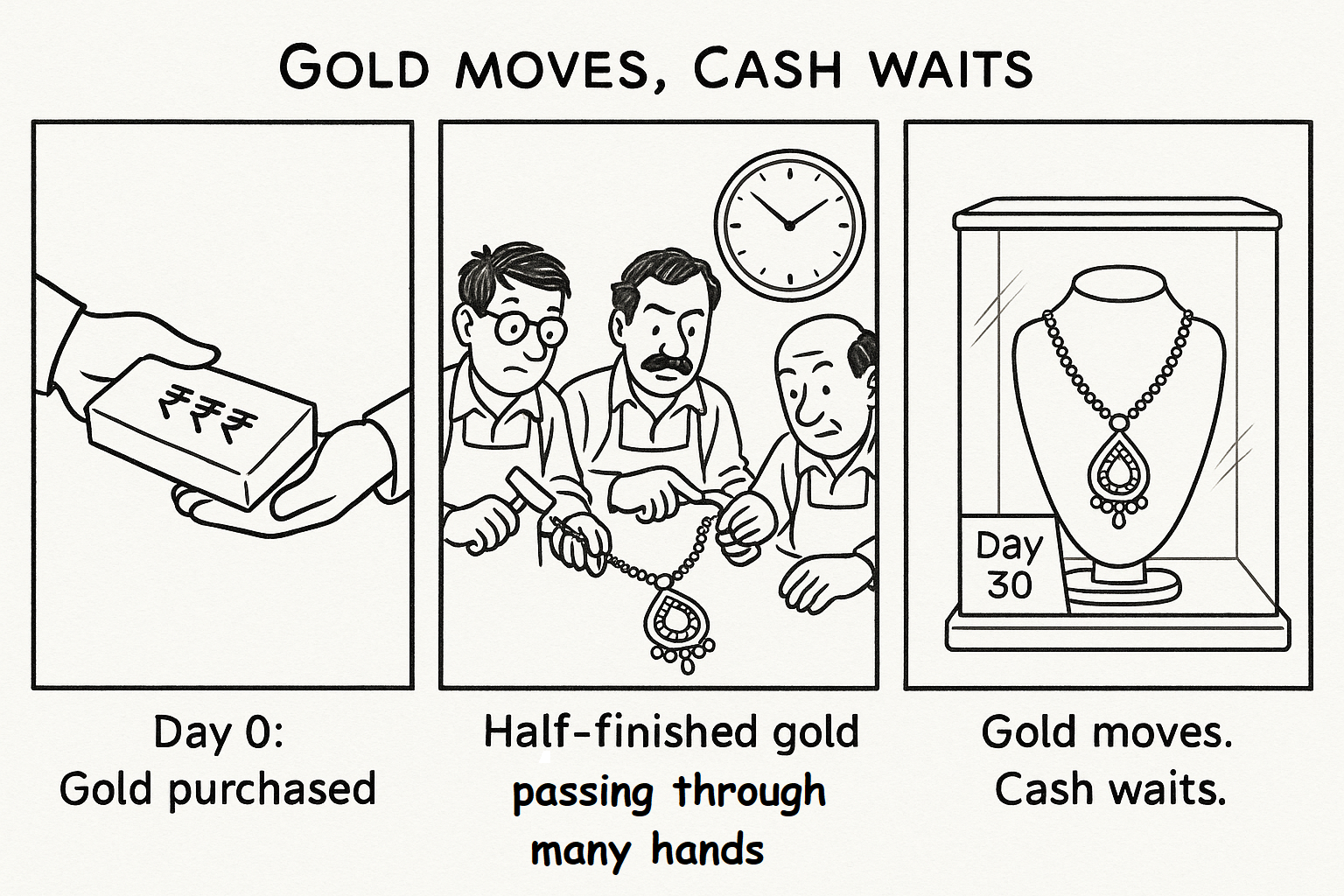
Jewellery Business Models - Episode 4 If Episodes 1–3 dealt with gold, cash, and clear archetypes , Episode 4 deals with what most banks actually struggle with: Businesses that look like retailers, sound like manufacturers, handle inventory like owners, but behave like intermediaries. This is the grey zone of jewellery lending — where risk does not disappear, it merely relocates. Most stress in jewellery portfolios does not originate from: pure retailers, clear manufacturers, or transparent job-workers.
It originates from models that sit between trade and finance , where: ownership is delayed, pricing is unfixed, inventory is reversible, and cash moves last. These models are legitimate. They are also frequently misfunded. ARCHETYPE 4: DISTRIBUTORS / WHOLESALERS / VENDOR-LINKED PLAYERS Core economic reality Jewellery is present physically Ownership is partial, delayed, or conditional Payment is linked to downstream sale Inventory exists — but balance-sheet ownership is ambiguous. 4A.
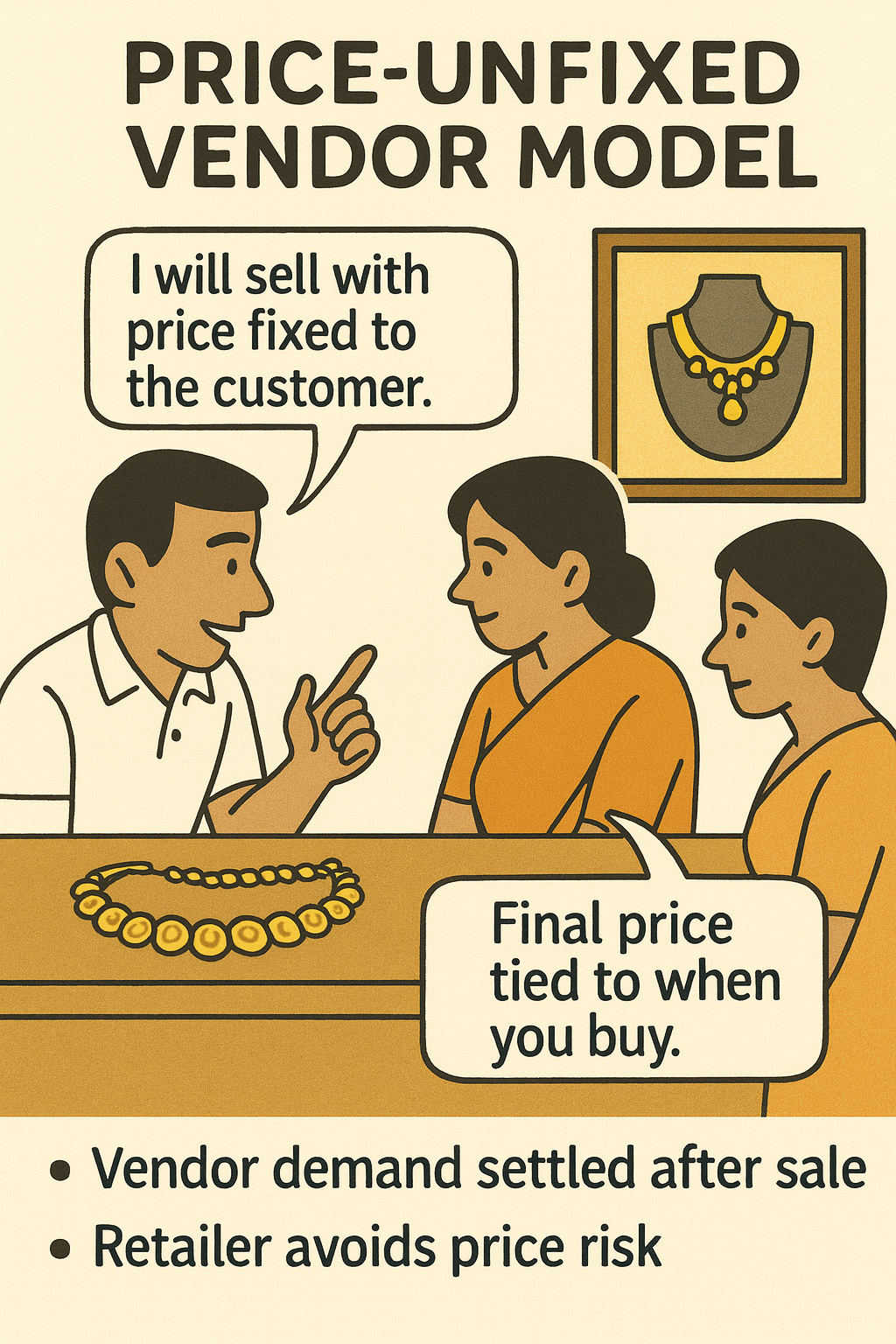
Price-Unfixed Vendor Model (Common in large chains and metros) How it works Jewellery received from manufacturer/vendor Price fixed only when final customer buys Payment made at prevailing gold rate What this achieves Retailer avoids price risk Inventory risk shifts upstream Capital requirement appears lower What banks often misread Treat stock as owned inventory Extend GML against it Hidden risk Inventory can be recalled Sale proceeds are first owed to vendor Bank sits behind an invisible creditor 4B.
Consignment-Based Distributor How it works Stock placed on display Unsold stock returnable Margin earned only on sale Economic truth Retailer sells without owning Balance sheet shows movement, not ownership Banking risk Funding non-owned inventory Inflated turnover without asset backing 4C. Bullion-Swap Distributor How it works Jewellery supplied against bullion exchange Cash settlement deferred Adjusted periodically Why it exists Reduces cash movement Aligns metal flows Risk zone MTM exposure hidden Liquidity stress if bullion prices swing 4D.
Non-Moving Stock Exchange Model How it works Slow designs returned Fresh designs substituted Why it appeals Retailer avoids obsolescence Why banks must pause Inventory value appears stable But monetisation is uncertain 4E. Semi-Owned Inventory Model How it works Partial payment made Balance settled post-sale Danger Looks like ownership Behaves like consignment Classic misclassification Treated as fully owned stock for WC/GML ARCHETYPE 5: OLD-GOLD / SCRAP AGGREGATORS These players do not sell jewellery — they move gold back into the system .
Core economic reality Scrap collection precedes refining Time and purity risk dominate Margins are thin, volumes large 5A. Exchange-Dominant Retailer Old gold inflow > fresh gold purchase Dual cycle strain: scrap + finished goods Banking blind spot Exchange appears “cash neutral” Actually locks capital twice 5B. Pure Scrap Aggregator Collects, refines, supplies bullion High price sensitivity Funding caution Gold exists briefly Liquidity only after refining 5C. Mobile / Doorstep Exchange Players Informal sourcing High purity and valuation risk Not a gold-loan candidate 5D.
Refinery-Linked Aggregator Faster turnaround Lower margin, lower inventory days Better structured, still volatile ARCHETYPE 6: HYBRID / MIXED MODELS (Where most NPAs are born) These businesses operate multiple archetypes simultaneously — often without internal separation. 6A. Retail + Vendor-Financed + Exchange Sales look strong Cashflows fragile Risk Bank funds inventory that is neither owned nor liquid 6B. Manufacturer + Distributor Produces some stock Distributes others’ designs Funding mismatch WC sized for manufacturing Actually supporting trade credit 6C.
Job-Work + Retail (No Separation) Entrusted gold shown as inventory Severe audit and collateral risk 6D. Retail + Bullion Trading MTM gains mask operating stress Price movement mistaken for business strength The Banker’s Reality Check (This Is the Line) In jewellery lending, risk does not vanish in hybrid models — it hides. The more “innovative” the structure sounds, the more important it is to ask: Who owns the gold today ? Who gets paid first when it sells? Who absorbs loss if it doesn’t?
Why Banks Struggle Most Here Because account statements: show turnover, not ownership, show inventory value, not recallability, show credits, not prior claims. And so: GMLs get stretched, rollovers become habits, stress appears suddenly. The Banker’s Reality Check In jewellery lending, risk does not vanish in hybrid models — it hides . The more “innovative” a structure sounds, the more important it is to pause and ask three uncomfortable questions: Who owns the gold today — legally, not operationally? Who gets paid first when a piece is sold? Who absorbs the loss if it doesn’t sell, is recalled, or is repriced?
If these answers are unclear, the bank is not funding inventory —it is funding a gap in ownership, timing, and accountability . That is why stress in jewellery portfolios rarely comes from: pure retailers, clean manufacturers, or transparent job-workers. It comes from grey-zone archetypes —where inventory moves, cash delays, and ownership floats. And that is the banker’s line. Not where gold exists.
But where risk crystallises . What Comes Next (Episode 5 Trailer) In the next episode, we step away from lending and into investing and schemes —gold savings plans, exchange-heavy models, accumulation structures, and “safe” promises. We’ll ask a simpler question: When gold doesn’t sit on your balance sheet — whose risk are you actually holding? Episode 5: The Schemes Around Gold — and the Risks They Don’t Advertise. Disclaimer This article is intended for educational and discussion purposes only .
The business models, structures, and archetypes described here are illustrative and drawn from observed industry practices. They do not refer to any specific entity, transaction, or borrower. This is not investment advice, credit advice, or a solicitation of any kind. Readers should not rely on this content as a substitute for professional judgment, independent assessment, or institution-specific credit policies. Any views expressed are personal and do not represent the views of any bank, regulator, employer, or institution, past or present.
Archive note
This essay was restored from Vivek Krishnan’s Wix journal. Its original wording and available visuals have been preserved.
This page is now the permanent canonical edition within Vivek Perspective.