Jewellery Business Series - Episode 7 Across multiple jewellery clusters, a recurring structure emerges — what I refer to as the Gold Timing Mismatch Pattern — where customer money arrives before gold is actually owned or hedged, creating temporary liquidity comfort that later reverses. Gold has always been seen as safe. So when jewellery businesses fail, the instinct is to look for fraud, bad intent, or regulatory crackdowns.
But across India, a quieter story keeps repeating. Customer money arrives early. Gold ownership comes later. Liquidity looks strong — until timing catches up. This is not a Sowcarpet story. It is a pattern . This episode examines a recurring structure observed through public reporting, balance-sheet signals, and enforcement timelines — what I call the: Gold Timing Mismatch Pattern A risk pattern where money precedes the asset , creating temporary comfort that reverses under stress.
The Pattern — Broken into Components Across cases, five elements recur in different combinations: Customer advances or gold-linked schemes Gold not immediately owned or hedged Reliance on export-linked / duty-free gold routes Liquidity distortion (suspense accounts, blocked funds) Delayed enforcement visibility (DRI / ED / Customs) No single case needs all five.
The stress emerges when three or more converge .
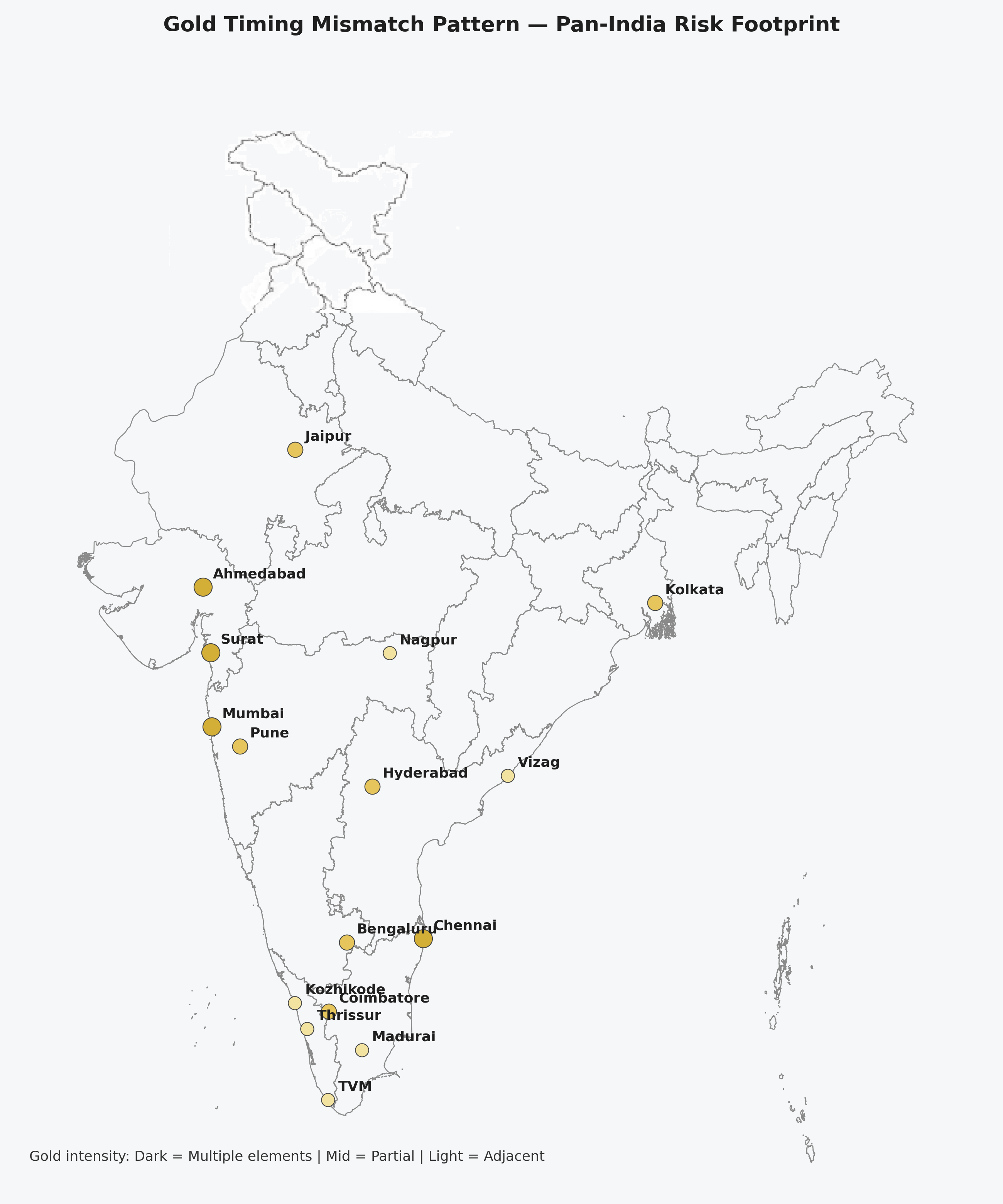
Map indicating multiple locations where the pattern occured Location / Cluster Reported Period Newspaper / Media Headline (Indicative) Pattern Variant Observed Sowcarpet / Chennai (TN) 2023–2024 The Hindu CBI registers case against jewellery exporters for misuse of gold import scheme Export-linked gold diversion + enforcement Sowcarpet / Chennai (TN) 2024 Business Standard DRI probes jewellery exporters for duty-free gold misuse Duty-free gold → liquidity freeze Mumbai (MH) 2022–2023 Times of India DRI busts gold export fraud involving mis declared jewellery shipments Mis declared exports Mumbai (MH) 2023 Indian Express Jewellery exporter booked for customs fraud in gold exports Paper compliance vs substance Surat (GJ) 2021–2022 Economic Times DRI investigates diamond & jewellery firms over export irregularities Export-incentive misuse Ahmedabad (GJ) 2022 Times of India Customs books jeweller for misusing advance authorisation scheme Advance Authorisation abuse Jaipur (RJ) 2021 Hindustan Times Gold jewellery exporter under scanner for undervaluation Export undervaluation Kolkata (WB) 2022–2023 Telegraph India Customs probes gold jewellery export discrepancies Early-stage export mismatch Hyderabad (TS) 2020–2021 Deccan Chronicle DRI raids jewellery firms over gold import-export violations Import-export compliance stress Bengaluru (KA) 2021 The Hindu DRI detects diversion of duty-free gold meant for exports Duty-free diversion Coimbatore (TN) 2022 Times of India Jewellery units face customs scrutiny over export claims Export vs inventory mismatch Kerala (TVM cluster) 2020–2021 The Hindu ED attaches assets in gold smuggling probe Enforcement-led liquidity seizure Kerala (Statewide) 2022 Indian Express ED tightens noose on gold smuggling network Regulatory shock Visakhapatnam (AP) 2023 The Hindu Customs seizes gold at port; probe widens Port-linked diversion Delhi NCR 2021–2022 BusinessLine Jewellery exporters under scanner for misuse of export incentives Incentive misuse The map does not claim identical incidents everywhere.
It shows that elements of the same timing and liquidity-risk pattern have surfaced across multiple jewellery hubs, often long before enforcement action became visible. Balance sheets can look healthy until they suddenly don’t Many affected entities: showed profits showed turnover growth complied on paper right until liquidity froze. A pattern is established not by identical incidents , but by the repeated appearance of the same structural stresses.
Across multiple jewellery clusters , we observe a recurring sequence : customer money arriving before gold is owned, reliance on export-linked gold routes, temporary liquidity comfort on balance sheets, and eventual stress once cash becomes restricted or obligations mature. The geographic spread and temporal recurrence of these elements point to a systemic timing risk rather than isolated events.
When we overlay reported periods , a consistent lag appears: Business practices run for years Balance sheets remain compliant Stress surfaces only when: schemes mature, or liquidity is restricted, or gold prices move sharply Key insight: Regulatory action is a lagging indicator , not an early-warning signal. For bankers, waiting for enforcement visibility is waiting too late .
The Essential Loophole: Timing Was Not Regulated — Only Compliance Was At the heart of everything you mapped lies one fundamental loophole : The system regulated gold compliance, but not gold timing. More precisely: Regulations focused on documentation, declarations, and eligibility They did not enforce when gold had to be: owned, hedged, or monetised,relative to customer money.
This created space for a dangerous assumption: If paperwork is compliant, liquidity must be real. That assumption turned out to be wrong. How This Loophole Drove Everyone into the Same Pattern Because timing was unregulated, three things became possible — and attractive. (a) Customer money could legally arrive before the asset Advance schemes, rate-freeze plans, and pre-booking models were allowed without mandatory asset backing at that point in time. So: Cash looked strong Balance sheets looked liquid But gold exposure was deferred This is the first hinge of the pattern.
(b) Export-linked gold routes filled the timing gap To bridge the gap between: customer commitments today, and gold procurement later, players leaned on: duty-free imports, advance authorisation, export-linked replenishment. These were legal routes , but they carried timing risk , not just compliance risk. This is the second hinge . (c) Banks evaluated eligibility, not cash-flow reversibility Bank appraisal frameworks asked: Is the scheme allowed? Is the export eligible? Is the paperwork compliant? They did not consistently ask: What happens if this cash becomes unavailable tomorrow?
How quickly can this gold obligation be funded without exports? This is the third hinge — and where the pattern silently matured. So What Was the Single Structural Loophole in The Gold Timing Mismatch Pattern If we reduce everything to one sentence: There was no requirement to align customer money, gold ownership, and liquidity reversibility within the same time window. That is the loophole. Not fraud. Not geography. Not intent. Timing asymmetry - The Gold Timing Mismatch Pattern This pattern did not emerge because rules were broken. It emerged because timing was ignored. A blind spot !
Archive note
This essay was restored from Vivek Krishnan’s Wix journal. Its original wording and available visuals have been preserved.
This page is now the permanent canonical edition within Vivek Perspective.