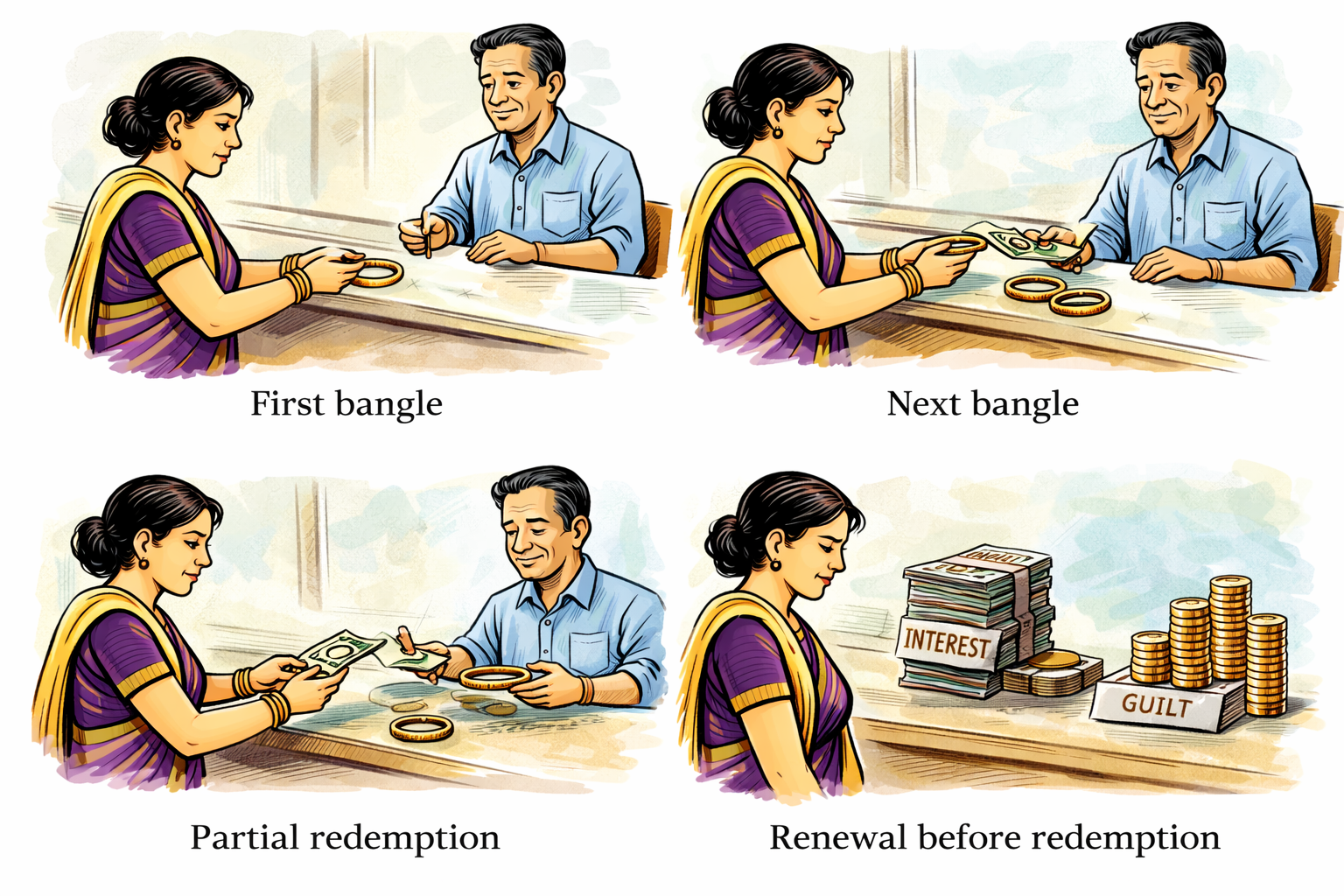
Bangles: Behaviour, Duration & What Time Reveals ORNAMENT Sub Series : Gold Jewellery Funding : Episode 18 Sunita didn’t pledge her necklace again. She chose bangles. One bangle at first. Then another, a few months later. Each decision felt temporary Each pledge felt reversible. Six months passed. The bangles were still at the bank. This episode is about that quiet stretch of time —where bangles stop being ornaments and start becoming signals.
How a Banker Sees Bangles Not as a single pledge, but as a sequence Not emotional value, but renewal probability Bangles as indicators of: duration risk income instability gradual stress, not shock How a Borrower Feels Bangles “Just one more bangle” Lower emotional resistance than necklaces Incremental normalisation of debt Guilt deferred, not confronted Behaviour Patterns Unique to Bangles First bangle pledged easily Second bangle follows silently Partial redemption creates false relief Renewal becomes routine Full redemption keeps getting postponed Bangles reveal time-based stress , not event-based stress.
A Regional Exception: The Odisha Lac Bangle Case In parts of Odisha, traditional gold bangles follow a construction logic that differs materially from what a banker typically expects when assessing gold jewellery. These bangles are often not fully hollow , nor are they fully solid gold. Instead, they are crafted using a lac core — a natural resin historically used in jewellery and ornamentation — over which a thin layer of gold is applied and shaped. From a cultural and artisanal perspective, this is not adulteration.
It is a long-standing craft practice , designed to achieve visual fullness, durability, and affordability while preserving ceremonial aesthetics. From an appraisal perspective, however, this construction introduces a structural blind spot .
Why Lac Bangles Behave Differently at the Appraisal Desk Visually, lac-core bangles: Appear thick and substantial on the wrist Feel rigid and well-formed when handled Often resemble solid bangles in diameter and profile Operationally, however: A significant portion of the volume is non-gold mass Net gold weight is confined to the outer shell Conventional expectations of volume = weight fail This leads to a valuation discontinuity : what looks pledge-worthy to the borrower may appraise far lower than expected at the counter.
Why Traditional Tests Often Miss Lac Cores Most frontline appraisal methods are surface-biased : Sound test reflects rigidity, not density Touch and feel detect form, not composition Acid or rub tests confirm surface purity only XRF scanners typically read the outer gold layer In lac-core constructions, the gold shell passes these checks cleanly. The result is not misclassification, but over-confidence — unless a density-based assessment is applied.
Why the Buoyancy Test Matters Here The lac core materially alters the specific gravity of the ornament. When subjected to a buoyancy (water displacement) test , lac-filled bangles: Displace more water relative to gold weight Exhibit density values inconsistent with solid gold Reveal a mismatch invisible to surface tests This is why buoyancy testing — often skipped in high-volume counters — becomes the only reliable indicator in such regional constructs.
The Banker’s Operational Dilemma In practice, bankers face constraints: Limited time per customer High transaction volumes Sensitivity around damaging cultural ornaments Infrastructure not designed for multi-layer forensic testing As a result, many institutions de-risk by policy : Lower LTVs for bangles vs chains Conservative valuation for unusually thick profiles Preference for repeatable, predictable jewellery forms The Odisha lac bangle sits precisely at this intersection — culturally valid, structurally complex, and operationally inconvenient .
Why This Matters Beyond Odisha This is not an Odisha-only lesson. It illustrates a broader truth: Gold lending risks are not only about purity fraud — they are about construction logic mismatches between culture and collateral frameworks. For bankers, the takeaway is not suspicion — it is contextual literacy . For borrowers, it explains why certain bangles consistently appraise below expectation despite being “real gold.”
Operational Realities in Appraisal Repeat customers recognised faster than metals Banker memory > machine readings Renewal history influences comfort more than purity Bangles assessed individually, behaviour assessed cumulatively Loan Behaviour Matrix — Bangles Only Bangles Pledged Tenure & Renewal Pattern Partial Redemption Behaviour How a Banker Interprets This Underlying Borrower Condition 1 bangle Short tenure, often redeemed on first cycle Rare or none Tactical liquidity usage Temporary cash gap; confidence intact 2 bangles (same visit) One or two renewals Occasional partial redemption Planned borrowing, still controlled Cash-flow mismatch, not stress 2 bangles (staggered visits) Renewals begin to stack One bangle redeemed, one retained Stress emerging, borrower pacing exposure Income variability; cautious optimism 3–4 bangles Multiple renewals across cycles Partial redemption creates relief illusion Duration risk increasing Stress normalised; recovery deferred 5–6 bangles (matched set broken) Renewals routine, redemption postponed Small redemptions, quickly re-pledged Structural dependence forming Sustained cash strain; obligations outrunning income Full set (6/8/12 bangles) Long tenure, repeated renewals Rare full redemption High emotional and duration risk Family-level financial stress Incremental additions over time Tenure keeps extending Redemption lags far behind pledge Loan becoming semi-permanent Debt normalisation; hope-driven rollover No redemption, only renewals Extended tenure beyond original intent None Dormant stress Borrower waiting for a break that hasn’t come Sudden bulk redemption Early closure after long tenure All at once External liquidity event Sale, windfall, support, or forced reset Behaviour Summary — What Bangles Ultimately Signal Observed Bangle Behaviour What It Appears Like What It Actually Signals Why It Matters to a Banker Pledging one bangle first Minimal sacrifice Testing stress waters Early indicator of liquidity anxiety Adding bangles gradually Small, manageable decisions Stress is persistent, not temporary Duration risk building silently Breaking a matched set Practical choice Emotional threshold crossed Household-level strain Partial redemptions Signs of recovery Relief without resolution False positives in monitoring Frequent renewals Normal loan maintenance Inability to exit Stress has been normalised Long tenure with no additions Stable behaviour Stagnation, not stability Watch-list candidate Full set pledged at once One-time decision Event-driven distress High emotional and recovery risk Hollow/lightweight bangles Bulky visual comfort Value illusion Expectation mismatch at appraisal Stone-studded bangles Ornamental value Non-recoverable mass Collateral efficiency erosion Sudden full redemption Happy ending External liquidity event Not repeatable behaviour Never redeemed, only renewed “Loan in use” Deferred distress Latent default risk Re-pledging after redemption Cyclical usage Structural dependency Semi-permanent credit reliance SUMMARY : Bangles do not arrive at the counter all at once.
They arrive one at a time — quietly, cautiously, almost apologetically. To the banker, they form a pattern of renewals, partial redemptions, and dates that stretch forward. To the borrower, they represent hope deferred — month after month. What looks like manageable liquidity on the ledger often masks prolonged stress at home. Disclaimer: This episode is intended as an observational and educational exploration of borrower and banker behaviour in gold-backed lending. It does not comment on any individual, institution, region, or community, nor should it be read as financial, legal, or valuation advice.
All illustrations and narratives are representative patterns drawn from long-term industry experience.
Archive note
This essay was restored from Vivek Krishnan’s Wix journal. Its original wording and available visuals have been preserved.
This page is now the permanent canonical edition within Vivek Perspective.