Justice, Scheduled—But Not Served
Listed, But Not Heard: The Accountability Gap in Justice Delivery
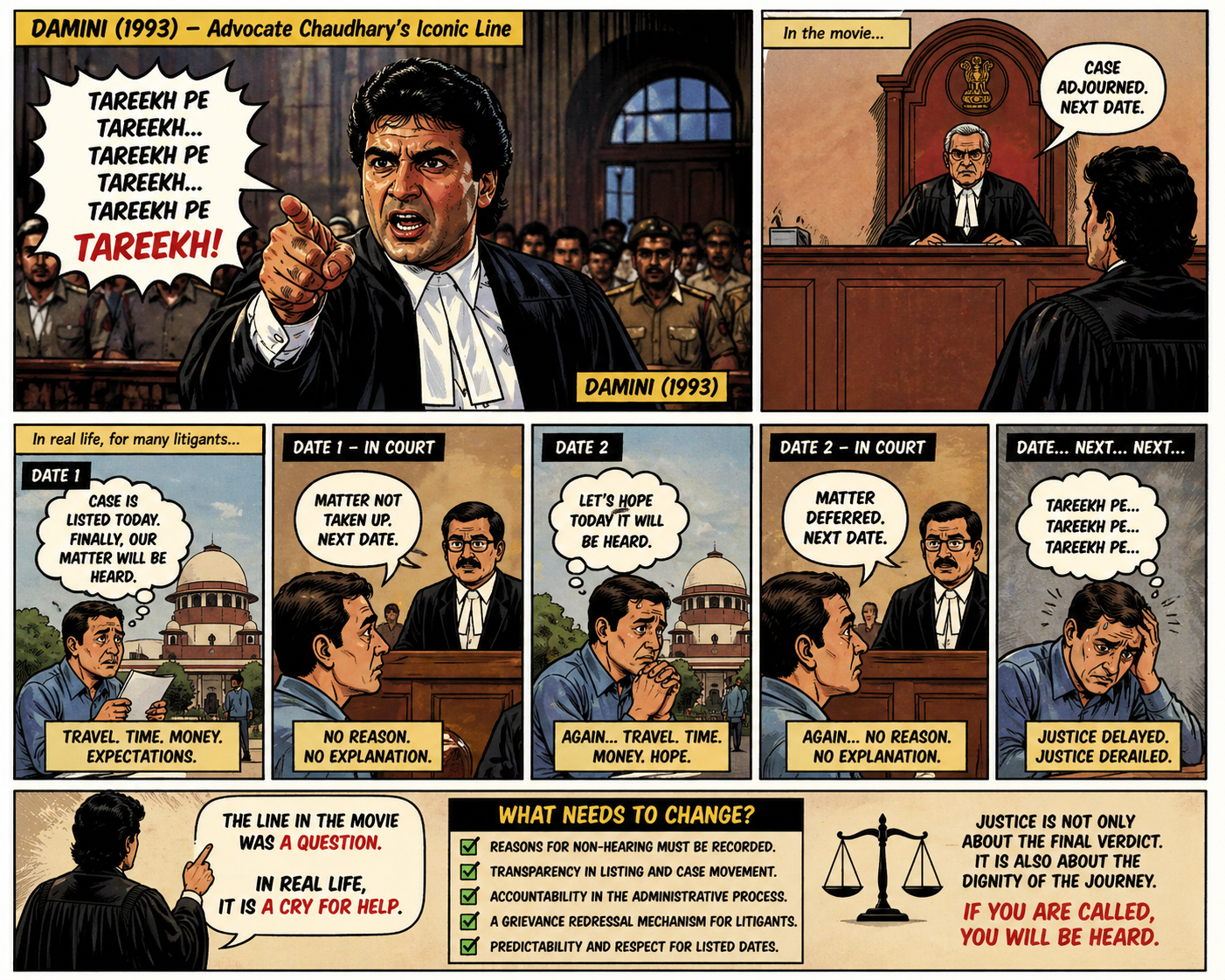
We smiled when Advocate Chaudhary delivered that iconic line in Damini. It felt exaggerated. Dramatic. Cinematic.
But for many litigants today, it is no longer cinema. It is routine.
We often speak about delay in justice—the years, sometimes decades, it takes for a matter to conclude. That is a well-acknowledged challenge.
But there is another layer to this problem—quieter, less discussed, and perhaps more frustrating:
Uncertainty even on the day a case is listed to be heard.
The Invisible Problem
A matter is listed before the Supreme Court of India.
The litigant prepares. Counsel is briefed—often senior counsel, with significant fees. Travel plans are made. Expectations are built.
And then…
The matter is not taken up. No reason is recorded. No explanation is offered. No recourse exists.
The case simply moves to another date.
This Is Not About Pendency Alone
Yes, India has a massive judicial backlog:
Over 4.5 crore cases pending across courts
Around 70,000+ cases pending in the Supreme Court itself
But pendency explains delay in final outcomes.
It does not explain why:
A matter that is already listed
On a designated date
With all parties present
…is not heard, without any stated reason.
A listed matter is not a courtesy. It is a commitment.
The Cost That No One Measures
When a case is not heard on the scheduled date, the cost is not administrative—it is deeply human:
Financial cost: Counsel fees for a non-hearing
Opportunity cost: Business, employment, and personal commitments disrupted
Emotional cost: Repeated uncertainty, loss of faith
For many litigants, especially those without deep pockets or influence, this is not an inconvenience—it is a burden.
The Accountability Vacuum
The administrative side of the Court—particularly listing and scheduling—operates within an internal framework.
The Chief Justice functions as the Master of the Roster
The Registry executes listing
But from a citizen’s perspective, a critical question remains unanswered:
Who explains why a listed matter was not heard?
There is:
No formal disclosure of reasons
No publicly accessible audit trail
No grievance redressal mechanism for listing-related issues
Accountability, as it stands, is internal—not citizen-facing.
A Question of Perception—and Equity
There is also a growing perception—rightly or wrongly—that certain matters receive priority attention.
High-visibility cases appear to move faster. Urgency, at times, seems easier to establish for some than for others.
This is not to question intent—but to acknowledge perception.
And in any justice system:
Perception of fairness is as important as fairness itself.
The Leaf We Lost Along the Way
India’s judicial system draws from a rich common law legacy.
The system from which we inherited this framework did not eliminate delay—but it built strong norms around procedural predictability and administrative discipline.
Somewhere along the way, we seem to have drifted:
From structured process To discretionary opacity
This is not about comparison. It is about introspection.
What Can Change
The solutions are not radical—they are administrative:
Disclosure of reasons when listed matters are not taken up
Digital audit trails for cause list movement
Greater predictability in daily listing
A simple grievance channel for litigants
These are not demands for reform of law. They are calls for strengthening of process.
A Simple Expectation
Justice is not only about the final verdict.
It is also about the dignity of the journey.
When a citizen comes to the highest court of the land, the expectation is modest:
If you are called, you will be heard.
Until that expectation becomes reality,“Tareekh pe tareekh” will remain more than a line from a film.
It will remain a lived experience.
Archive note
This essay was restored from Vivek Krishnan’s Wix journal. Its original wording and available visuals have been preserved.
This page is now the permanent canonical edition within Vivek Perspective.