Gold Jewellery Business Series - Episode 12 If risk in gold jewellery lending surfaces at exit, the harder question is this: why does the system continue to behave as if exit will never be tested? Episode 11 showed where gold-loan risk surfaces. Episode 12 asks why institutions keep walking toward it.
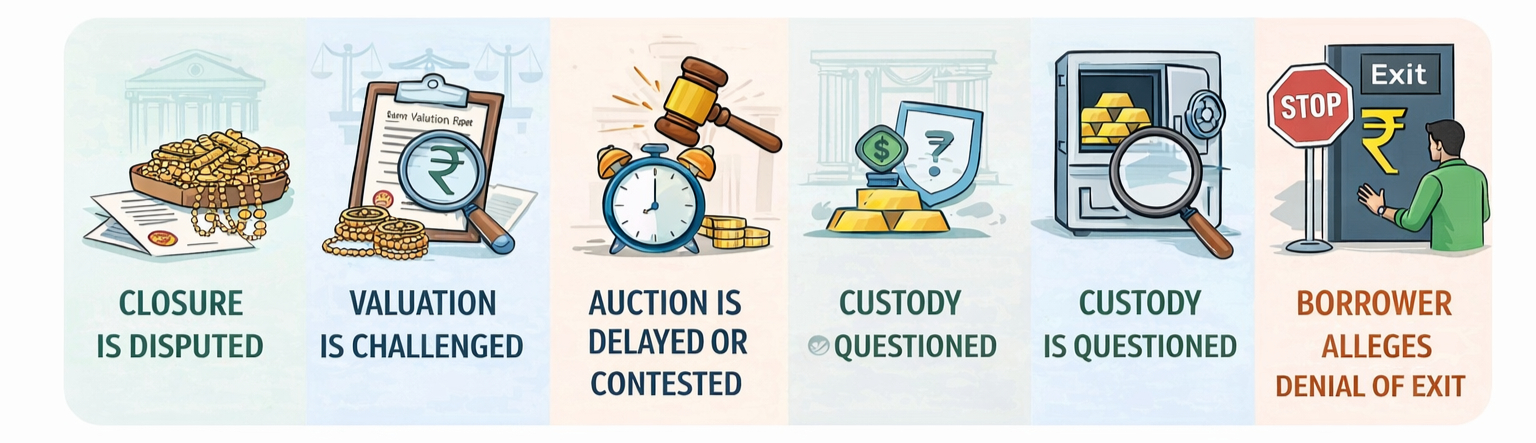
Legal Event Type PSU Bank (BOI) Private Bank (ICICI) RRB (Odisha GB) Cooperative Banks Interpretation Closure Disputed ✔️ Multiple reported consumer & HC cases ✔️ Consumer forum cases ✔️ Audit & fraud cases ✔️ Frequent Exit is contested, not default Valuation Challenged ✔️ Yes ✔️ Yes ✔️ Yes ✔️ Yes Valuation fairness litigated Auction Contested / Delayed ✔️ Yes ✔️ Yes ✔️ Yes ✔️ Yes Enforcement timing scrutinised Custody Questioned ✔️ FIR / SC matter ❌ Rare ✔️ Yes ✔️ Yes Custody risk non-zero Denial of Exit Alleged ✔️ Yes ✔️ Yes ✔️ Yes ✔️ Yes Core recurring theme Key Point : These events surface not through NPAs, but through courts, tribunals, and audits — indicating that gold loan risk manifests as process disputes , not credit failure.
PART C — WHY GOLD LOANS RARELY FAIL LEGALLY ON CREDIT GROUNDS Across cases: Borrowers often service interest Collateral value usually exceeds exposure GNPA classification is irrelevant to dispute Courts do not ask: “Did the loan default?” They ask: “Was the exit fair?” A gold loan that never defaults can still lose in court. A gold loan that never closes can still expose the bank.
This section does not argue that gold loans are risky in the conventional sense. It argues that they are evaluated using the wrong risk lens. Courts do not adjudicate gold loan disputes on the basis of delinquency or recovery. They examine whether borrowers were given a fair, timely, and transparent exit. For banks, this means that credit comfort does not translate into legal comfort.
The risk that matters surfaces only when closure is attempted — not while the loan continues. If courts are consistently testing exit fairness, why do banks continue to design gold loans around renewal convenience instead of closure proof ? PART D — THE LEGAL METRIC THAT MATTERS (UNSPOKEN) ⏱️ Time Since Last Zero Outstanding (TSZO) Though not named explicitly, courts indirectly test: How long the loan remained open Whether closure was realistically possible Whether renewals replaced resolution Legal Reality: A loan that never closes attracts legal attention even if it never defaults.
Time Since Last Zero Outstanding (TSZO) is not a regulatory term, but it captures the lifecycle variable courts repeatedly probe in gold-loan disputes: whether the exposure ever demonstrably ended. A gold loan can remain standard through interest servicing and repeated renewals, but if it never resets to zero outstanding, it never proves self-liquidation in the observable sense.
When enforcement or closure is eventually attempted, disputes tend to pivot on questions of redemption opportunity, notice, valuation fairness, and custody integrity — all of which become more sensitive when the loan has remained continuously open across multiple cycles. In this way, courts indirectly test TSZO without naming it: not “did the borrower default?” , but “was exit realistically available and fairly executed?” If TSZO is the real risk signal, why don't banks measure it and govern against it ?
PART E — REGULATORY–LEGAL CONVERGENCE Recent RBI directions emphasise: Renewal discipline Top-up governance Valuation standardisation Borrower exit rights Legal Reading: Regulation is pre-empting litigation by forcing lifecycle hygiene. What does “regulatory–legal convergence” actually mean? It means this: Regulators and courts are responding to the same risk — but from different ends of the lifecycle. Courts see the problem after it explodes (disputes, litigation, FIRs). Regulators try to prevent the explosion by enforcing hygiene before exit is tested. They are not acting independently.
They are converging on the same behavioural failure . Why RBI’s focus areas are not accidental (Gold Loan Life Cycle Risk) Let’s take each regulatory emphasis and map it to what courts have already flagged. 1️⃣ Renewal discipline What RBI says: Track and govern renewals; avoid rolling exposures without assessment. What courts have been saying (implicitly): Repeated renewals blur borrower expectations and weaken enforcement credibility.
Why this matters: Renewal without closure increases TSZO, which courts read as de facto perpetuity , not short-term lending. 2️⃣ Top-up governance What RBI says: Top-ups must follow fresh appraisal and clear policy. What courts encounter: Borrowers allege evergreening — “I was allowed to continue instead of being told to close.” Why this matters: Uncontrolled top-ups substitute resolution with extension, making exit legally contestable. 3️⃣ Valuation standardisation What RBI says: Uniform assaying, valuation protocols, audit trails.
What courts examine: Whether auction valuation was fair, transparent, and defensible. Why this matters: Valuation disputes are the most common litigation trigger in gold loans — and the easiest for borrowers to contest. 4️⃣ Borrower exit rights What RBI says: Clear redemption windows, transparent communication, timely release of gold. What courts enforce: Right to redeem pledged property until lawfully extinguished.
Why this matters: Exit denial transforms a civil lending dispute into a constitutional fairness issue. The deeper point (this is the real importance) RBI is not reacting to bank balance sheets. It is reacting to courtrooms. By tightening lifecycle hygiene, RBI is trying to: reduce disputes before they arise, protect borrowers without waiting for litigation, protect banks from legal and reputational escalation. That is preventive supervision , not punitive regulation.
PART F — THE CORE LEGAL CONCLUSION 🧠 **Gold loans do not fail in recovery. They fail in closure governance. ** And when closure governance fails: Courts intervene Compensation replaces collateral comfort Process defeats security Traditional banking belief A secured loan “fails” when: collateral is insufficient, or recovery is delayed or impaired. Gold loans rarely do this.
So bankers conclude: “Gold loans don’t fail.” That conclusion is incomplete . Gold jewellery loans rarely fail because recovery is inadequate; collateral value usually exceeds exposure, and enforcement is operationally straightforward. However, repeated judicial scrutiny shows that gold loans fail at a different point — closure governance. When closure is poorly handled, courts intervene not to dispute the bank’s right to recover, but to examine whether enforcement was fair, proportionate, and procedurally sound.
In such cases, collateral comfort offers little defence. Compensation, damages, and adverse findings replace recovery outcomes, and procedural lapses defeat otherwise strong security. This is why gold loan risk manifests legally even when credit performance appears pristine. In gold loans, security protects recovery — but only process protects legitimacy. ONE-LINE SUMMARY In gold jewellery lending, law does not punish default. It punishes denied exit.
COBIT / ISACA Lens for Gold Loan Lifecycle Risk Management Gold loan portfolios (Gold Loan Lifecycle Risk) rarely fail on credit outcomes; they fail on governance outcomes. Using COBIT-style thinking, the critical risks are renewal governance (evergreening), valuation integrity, custody chain-of-control, enforceability process, and borrower exit rights. Therefore, the right KRIs are not GNPA and overdue rates alone, but lifecycle indicators: Time Since Last Zero Outstanding (TSZO), closure SLA adherence, custody exceptions, valuation discrepancy rates, and auction contest rates.
This reframes gold lending as a secured product that still demands “information-security-grade” controls over evidence, custody, and exit fairness. Presenting 2 tables Table A (Governance Signals) and Table B (Legal Visibility) , the inference is : Risk is not where governance looks weak, nor where litigation looks high. Risk is where the two diverge.
How to read the tables Strong governance + Low legal visibility → lifecycle controls working Developing governance + High legal visibility → risk crystallising publicly Strong governance + Moderate legal visibility → scale effect / legacy exposures Adequate governance + Low visibility → watch TSZO and renewal behaviour TABLE A — Governance & Supervisory Signal–Based Banding (Anchored in operating model disclosures, RBI actions where public, audit narratives, and scale/structure of gold lending) Band meaning (for reference): Strong = explicit, centralised, auditable lifecycle controls Adequate = controls exist, some branch dependence Developing = controls uneven / renewal-heavy behaviour Weak = informal / highly variable governance Bank Segment Renewal Discipline Valuation Standardisation Custody & Chain of Control Exit / Closure Governance State Bank of India PSU Developing Adequate Adequate Developing Bank of Baroda PSU Developing Adequate Adequate Developing Punjab National Bank PSU Developing Adequate Adequate Developing Union Bank of India PSU Developing Adequate Adequate Developing Bank of Maharashtra PSU Developing Adequate Adequate Developing Canara Bank PSU Developing Adequate Adequate Developing Indian Overseas Bank PSU Developing Adequate Adequate Developing HDFC Bank Private Adequate Strong Strong Adequate ICICI Bank Private Adequate Strong Strong Adequate Axis Bank Private Adequate Strong Strong Adequate IDFC FIRST Bank Private Adequate Strong Strong Adequate RBL Bank Private Adequate Adequate Adequate Adequate Federal Bank Private Adequate Adequate Adequate Adequate City Union Bank Private Developing Adequate Adequate Developing DCB Bank Private Adequate Adequate Adequate Adequate South Indian Bank Private (Regional) Developing Adequate Adequate Developing Karnataka Bank Private (Regional) Developing Adequate Adequate Developing Karur Vysya Bank Private (Regional) Developing Adequate Adequate Developing Tamilnad Mercantile Bank Private (Regional) Developing Adequate Adequate Developing AU Small Finance Bank SFB Adequate Strong Strong Adequate Equitas Small Finance Bank SFB Adequate Strong Strong Adequate Ujjivan Small Finance Bank SFB Adequate Strong Strong Adequate ESAF Small Finance Bank SFB Adequate Strong Strong Adequate Jana Small Finance Bank SFB Adequate Strong Strong Adequate Suryoday Small Finance Bank SFB Adequate Strong Strong Adequate Capital Small Finance Bank SFB Adequate Adequate Adequate Adequate North East Small Finance Bank SFB Developing Adequate Adequate Developing Unity Small Finance Bank SFB Adequate Strong Strong Adequate How Option A reads: “How mature does each bank appear from a governance and operating-model lens, before any dispute arises?”
Table B — Legal / Dispute Visibility–Based Banding (Anchored in observable consumer forum cases, High Court orders, Supreme Court matters, and media-reported litigation over gold loans) Band meaning (for reference): High = repeated or visible legal disputes Moderate = sporadic but recurring disputes Low = rare / limited visibility Minimal = negligible public visibility Bank Segment Legal Dispute Visibility (Gold Loans) Typical Trigger Observed State Bank of India PSU High Auction timing, renewal vs closure Bank of Baroda PSU Moderate Valuation, auction notice Punjab National Bank PSU High Closure disputes, auction Union Bank of India PSU Moderate Enforcement timing Bank of Maharashtra PSU Moderate Renewal / valuation Canara Bank PSU Moderate Auction procedure Indian Overseas Bank PSU Moderate Closure / custody HDFC Bank Private Moderate Renewal vs auction ICICI Bank Private Moderate Auction notice, valuation Axis Bank Private Low Isolated consumer disputes IDFC FIRST Bank Private Low Limited visibility RBL Bank Private Low Rare Federal Bank Private Low Rare City Union Bank Private Moderate Regional borrower disputes DCB Bank Private Low Minimal South Indian Bank Private (Regional) Moderate Closure, custody Karnataka Bank Private (Regional) Moderate Auction / valuation Karur Vysya Bank Private (Regional) Moderate Closure disputes Tamilnad Mercantile Bank Private (Regional) Moderate Custody / exit AU Small Finance Bank SFB Low Minimal Equitas Small Finance Bank SFB Low Minimal Ujjivan Small Finance Bank SFB Low Minimal ESAF Small Finance Bank SFB Low Minimal Jana Small Finance Bank SFB Low Minimal Suryoday Small Finance Bank SFB Low Minimal Capital Small Finance Bank SFB Moderate Regional disputes North East Small Finance Bank SFB Moderate Custody / valuation Unity Small Finance Bank SFB Low Minimal How Table B reads: “Where does risk surface publicly when lifecycle governance is tested in courts?”
When viewed together, the two tables show that legal risk in gold jewellery lending does not track governance maturity in a linear way. Some institutions with apparently adequate controls still attract disputes, while others with developing controls show limited litigation. The gap is explained by exposure vintage and renewal behaviour rather than by security or credit quality.
This divergence reinforces the central argument of this series: gold loan risk manifests at exit, not at default. Independent analysis by me across balance sheets and reports reinforces the idea that legal risk in gold jewellery lending arises from lifecycle governance issues such as renewal behaviour and closure fairness, not from traditional credit performance metrics. Disclaimer This article is intended solely for academic, policy, and professional discussion.
All case references are based on publicly reported judicial orders and media reports, and are used to illustrate systemic behavioural patterns in gold jewellery lending rather than to comment on the conduct, intent, or governance quality of any specific institution or individual. No inference is drawn regarding portfolio quality, regulatory compliance, or current practices of the banks referenced. Figures, observations, and illustrations are not based on internal bank data and should not be construed as quantitative assessments of risk or performance.
The views expressed are personal and represent an analytical perspective on lending behaviour and legal outcomes, not legal advice or regulatory interpretation.
Archive note
This essay was restored from Vivek Krishnan’s Wix journal. Its original wording and available visuals have been preserved.
This page is now the permanent canonical edition within Vivek Perspective.