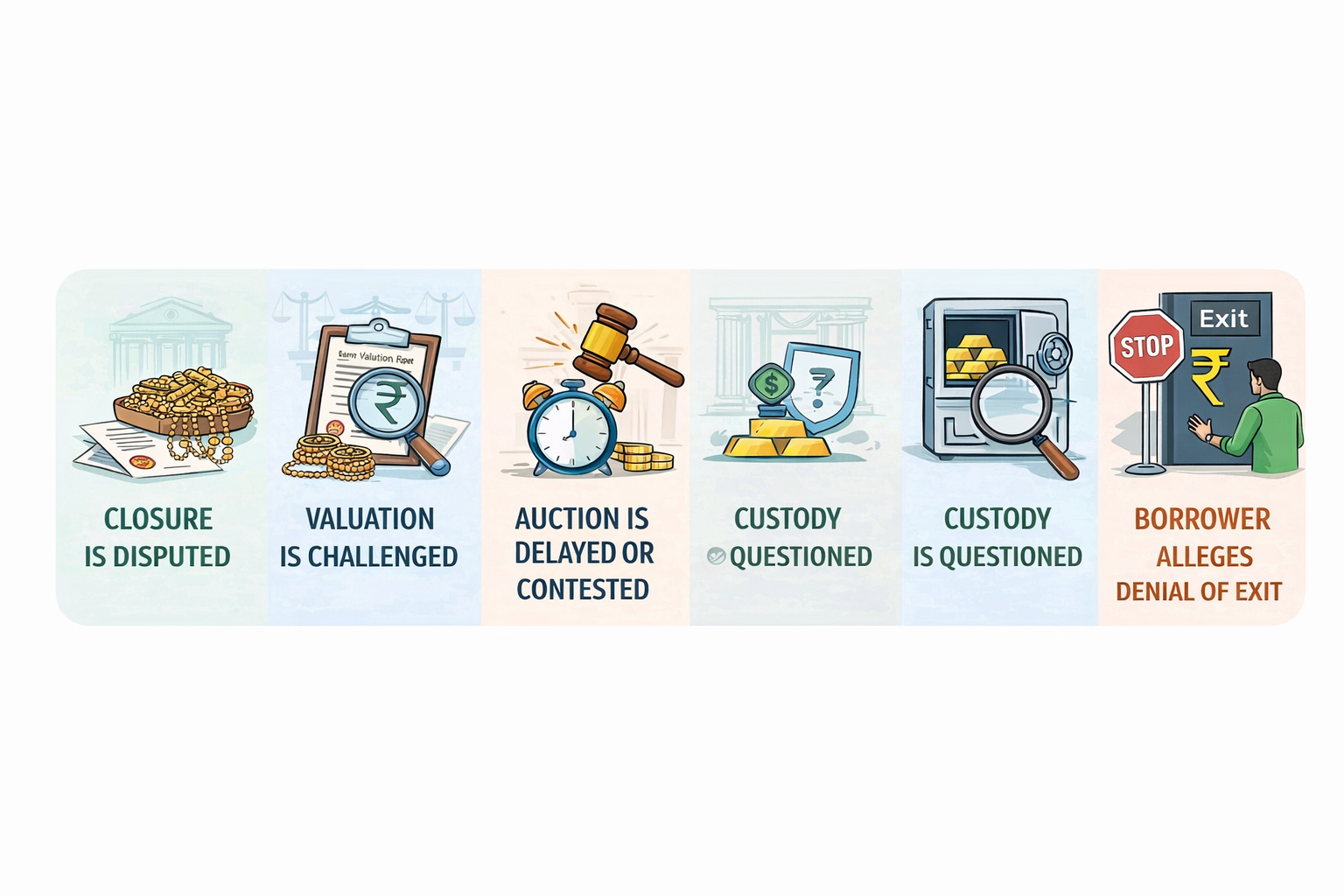
The Legal Lifecycle: Where Gold Loan Risk Actually Surfaces Gold Jewellery Series - Episode 11 PART A — WHEN GOLD LOANS ENTER THE LEGAL DOMAIN ⚖️ Trigger Points (Not Defaults) Gold loans enter courts and tribunals not because borrowers default , but because: Closure is disputed Valuation is challenged Auction is delayed or contested Custody is questioned Borrower alleges denial of exit Legal scrutiny begins at exit, not at delinquency.
Legal Event Type PSU Bank (BOI) Private Bank (ICICI) Regional / Gold-centric (SIB) Cooperative Banks What This Indicates Closure disputed 2–5 cases 1–3 cases 1–2 cases 3–6 cases Exit contested despite low NPAs Valuation challenged 1–3 1–2 1–2 2–4 Fairness > collateral Auction contested / delayed 2–4 1–3 1–2 3–5 Enforcement timing risk Custody questioned 1–2 Rare Rare 2–3 Process & control risk Denial of exit alleged 2–4 1–2 1–2 3–6 Lifecycle governance failure Footnote Incidence bands are based on publicly reported consumer forum orders, High Court proceedings, and FIR disclosures in the last ~24 months.
Banks do not publish consolidated dispute statistics for gold loans; figures reflect observable case frequency, not total occurrence. Gold jewellery loan risk does not surface as a measurable frequency of defaults; it surfaces as a repeatable pattern of exit-stage disputes across institutions. The non-availability of precise bank-wise dispute statistics is itself evidence that this risk bypasses traditional credit monitoring frameworks and manifests only when closure is attempted.
PART B — FIVE LEGAL FAULT LINES IN GOLD LOANS 🧩 1. Renewal vs Closure (Evergreening Risk) Legal Issue: Repeated renewals create borrower expectation and weaken enforcement credibility. What courts examine: Was full closure offered? Was renewal implied or encouraged? Was default artificial or procedural? Legal Insight: A loan repeatedly renewed begins to resemble a running account, not a short-tenor pledge. Ravi Kumar vs HDFC Bank.
📌 Case Details Case name Ravi Kumar vs HDFC Bank Forum District Consumer Disputes Redressal Commission, Coimbatore (Tamil Nadu) 📅 Year Loan transaction: 2008 Consumer dispute adjudication: 2011 (order passed) Public reporting / citation: 2012–2013 (widely referenced thereafter) A consumer forum case adjudicated in the early 2010s, arising from a 2008 gold loan transaction. 🧩 2. Valuation Disputes Legal Issue: Borrowers challenge auction outcomes citing undervaluation.
What courts examine: Method of assaying Transparency of valuation Timing of price reference Legal Insight: Collateral adequacy does not override procedural fairness. State of Maharashtra vs Bank of India Officials 📌 Case Details State of Maharashtra vs Bank of India Officials (Gold loan custody / post-repayment dispute) Court Supreme Court of India 📅 Year Underlying gold loan & FIR: Earlier years (prior to 2020) High Court quashing of FIR: 2023 Supreme Court decision (key event): 2024 👉 The Supreme Court order reinstating the FIR and allowing investigation was passed in 2024 . 🧩 3.
Custody & Chain of Control Legal Issue: Disputes over loss, substitution, or mishandling of pledged gold. What courts examine: Vaulting standards Custody logs Release documentation Legal Insight: Possession of gold increases duty of care, not immunity. (Supreme Court of India, 2024; reported by LiveLaw and The Times of India) 📌 Case Details (Custody & Chain of Control) Nature of case Gold loan custody / chain-of-control failure involving a co-operative bank , where pledged gold was: moved across branches, allegedly mishandled / misappropriated, leading to criminal allegations against bank officials.
⚖️ Court Supreme Court of India The Supreme Court intervened after a High Court had quashed the FIR , and held that the allegations were serious enough to require investigation . 🧩 4. Delayed or Contested Auctions Legal Issue: Auctions delayed due to renewals, then challenged as unfair. What courts examine: Adequacy of notice Reasonableness of timing Opportunity for borrower exit Legal Insight: Delay in enforcement weakens the lender’s legal posture. 📌 Case Used for Delayed / Contested Auction Mamina Mallick v.
Bank (Orissa High Court) Court: Orissa High Court Date of judgment: 22 October 2025 Reported by: New Indian Express and Times of India What happened: The High Court quashed a bank-conducted auction of pledged gold jewellery , finding that: the auction was premature (held before the 30-day statutory redemption period ), the bank violated its own contract terms , the process lacked procedural fairness and transparency. 📅 Year 2025 (Orissa High Court decision) This is a very recent case, making it especially relevant to Episode 11.
📰 Published / Reported Where Orissa High Court quashes bank’s gold auction — New Indian Express (Oct 22, 2025) Orissa High Court annuls gold auction for legal violation — Times of India (Oct 2025) These outlets reported the High Court setting aside a gold auction because the bank didn’t follow contractual or statutory safeguards. 🧩 5. Enforcement vs Borrower Rights Legal Issue: Borrowers allege denial of redemption opportunity.
What courts examine: Whether repayment was attempted Whether redemption was blocked Whether auction was the first response Legal Insight: Enforcement must follow exhaustion of fair exit options. 📌 Case Details Court Orissa High Court 📅 Year of the case Judgment delivered: 2025 Date reported: 22 October 2025 So the correct and safe way to state it is: A 2025 Orissa High Court decision on premature enforcement of a gold loan auction.
📰 Published / Reported where The judgment was independently reported by two mainstream national newspapers : New Indian Express Article: Orissa High Court quashes bank’s gold auction Date: 22 October 2025 Times of India Article: Orissa High Court annuls gold auction for violating loan terms Date: October 2025 Both reports describe the same High Court order , holding that: the auction was conducted before the statutory / contractual redemption period expired , and borrower’s right to redeem pledged gold was violated .
This episode limits itself to identifying and evidencing where gold-loan risk manifests. Structural responses and policy implications will be examined in the next episode. ( TO BE CONTINUED IN EPISODE 12 ) Disclaimer This article is intended solely for academic, policy, and professional discussion. All case references are based on publicly reported judicial orders and media reports, and are used to illustrate systemic behavioural patterns in gold jewellery lending rather than to comment on the conduct, intent, or governance quality of any specific institution or individual.
No inference is drawn regarding portfolio quality, regulatory compliance, or current practices of the banks referenced. Figures, observations, and illustrations are not based on internal bank data and should not be construed as quantitative assessments of risk or performance. The views expressed are personal and represent an analytical perspective on lending behaviour and legal outcomes, not legal advice or regulatory interpretation.
Archive note
This essay was restored from Vivek Krishnan’s Wix journal. Its original wording and available visuals have been preserved.
This page is now the permanent canonical edition within Vivek Perspective.