Part 2: What Works, What Doesn’t — And Why Gold Jewellery Funding - Episode 14 3. What RBI Permits (And Why It’s Often Misunderstood) 3. 1 Loans Against Gold Jewellery (Classic Gold Loans) Gold jewellery loans remain one of the cleanest secured retail products , because: Physical custody is taken Loan-to-value is capped Liquidation is straightforward Recovery experience is historically strong This explains why gold loans rarely fail on credit grounds — but often face legal scrutiny on process , as discussed in earlier episodes. 3.
2 Personal Loans & “Fungibility” A frequent argument is: “If I can take a personal loan and buy gold, why can’t a bank give a gold purchase loan?” Regulatory answer: Personal loans are not structured for a specific end-use RBI regulates product intent , not downstream misuse Designing a product for gold purchase is materially different from a borrower misusing a general-purpose loan 👉 Intent matters more than outcome. 4.
Credit Cards, EMI, and the MCC Mirage Another grey zone: Customers can sometimes buy gold on credit cards But EMI conversion is often blocked Some platforms allow it, others don’t Important clarification: This is not always an RBI prohibition Often it is: Card network rules Issuer-level Merchant Category Code (MCC) policies Risk appetite decisions Banks restrict EMI on jewellery because EMI = structured credit , not mere payment convenience. A credit card swipe is the customer drawing from a general-purpose revolving facility. EMI conversion is the bank restructuring that spend into a fixed-tenor installment loan.
Once it becomes structured credit, banks apply stricter end-use and category controls (via MCC), and jewellery/gold is often treated as a sensitive category from a regulatory, fraud, and conduct-risk standpoint. That’s why you may be allowed to buy jewellery on a card, but blocked from turning it into EMI. 5. Jeweller Schemes (10+1, 20+2, etc.) — Where They Stand Jeweller savings schemes are not loans by default .
They are commercial arrangements where: Customer contributes periodically Jeweller offers a benefit (discount / bonus month) Purchase happens later When they are generally acceptable: No assured return linked to gold price No third-party credit embedded Clear disclosures Funds treated as advance against future purchase When they attract regulatory discomfort: Funds pooled or leveraged Credit layered invisibly Guaranteed returns Third-party financing masquerading as savings 📌 Case: Jewellery Deposit Schemes Trigger SEBI / RBI Scrutiny In India, several jewellery retailers ran “gold savings” or periodic deposit schemes where customers paid instalments over a period (e.
g. , 10, 12, 20 months) and received gold or jewellery on maturity with bonuses or discounts. These became highly popular because they essentially acted as a way to accumulate gold over time with perceived price benefit. However, at least one such scheme drew formal regulatory action : Chemmanur International Jewellers — SEBI & RBI probe: A Kerala-based jewellery group was found to be running what regulators treated as deposit mobilisation without actual corresponding gold sales .
SEBI reported that the scheme collected nearly ₹998 crore from the public over FY2013–15, but actual gold sales were disproportionately low (≈₹66 crore), meaning customers’ funds were being held without equivalent delivery of metal. The regulator concluded this violated the RBI Act’s public deposit provisions, and SEBI intervened to examine the transactions under the public deposit framework.
This case doesn’t involve a bank or NBFC , but it is illustrative of the regulatory pushback that occurs when jeweller schemes begin to resemble deposit-taking disguised as advance payments — the very behaviour RBI and SEBI seek to guard against. 📌 What Happened (Regulatory Logic) Customers made advance payments to a jeweller under a scheme promising future delivery/benefits.
The corpus collected grew large relative to actual gold sold , suggesting funds were being held without clearance or delivery. SEBI and RBI Act provisions were invoked because this resembled public deposit mobilisation , which requires compliance with regulatory frameworks. The intervention occurred because: The scheme lacked adequate disclosure, Funds were pooled beyond simple purchase intent, The jeweller did not maintain a clear one-to-one sold/held obligation.
📌 Why This Matters This case is not about a gold loan per se, but it is directly relevant because: 🔹 It shows the regulator will not tolerate schemes that function like financial intermediation under the skin of commerce 🔹 It highlights that advance payments + deferred benefit + pooled funds can trigger public deposit law, even if the product is marketed as a “purchase scheme” 🔹 It reinforces the distinction : When structured schemes stop being straightforward transactions and start resembling deposit-credit hybrids, regulators step in.
This is a perfect illustrative news example to include under your section “Jeweller Schemes — Where They Stand.” 6. Can NBFCs “Help” Beyond 11–12 Months? This question has emerged repeatedly. The flawed idea: “NBFC can hold money (or wallet balance), jeweller gives discount, customer buys later.”
Regulatory reality: A wallet does not convert a prohibited end-use into a permitted one PPIs are payment instruments, not credit workarounds Holding customer funds triggers payments regulation + escrow rules If the underlying intent is gold purchase financing, risk remains 👉 Using structure to bypass substance increases regulatory exposure , it doesn’t reduce it.
Why regulators see through this structure Regulators do not evaluate gold-linked arrangements based on who holds the money or which entity touches the transaction . They examine: • Economic intent — Is credit being used to enable gold acquisition? • Functional outcome — Does the structure defer purchase while preserving price or benefit? • Risk transfer — Has market risk been shifted from the customer to the financial system?
If the answer is yes, the transaction is treated as gold purchase financing , irrespective of whether it flows through: • a wallet • an escrow • a jeweller scheme • an NBFC intermediary 👉 Form does not override substance in regulatory analysis. 7.
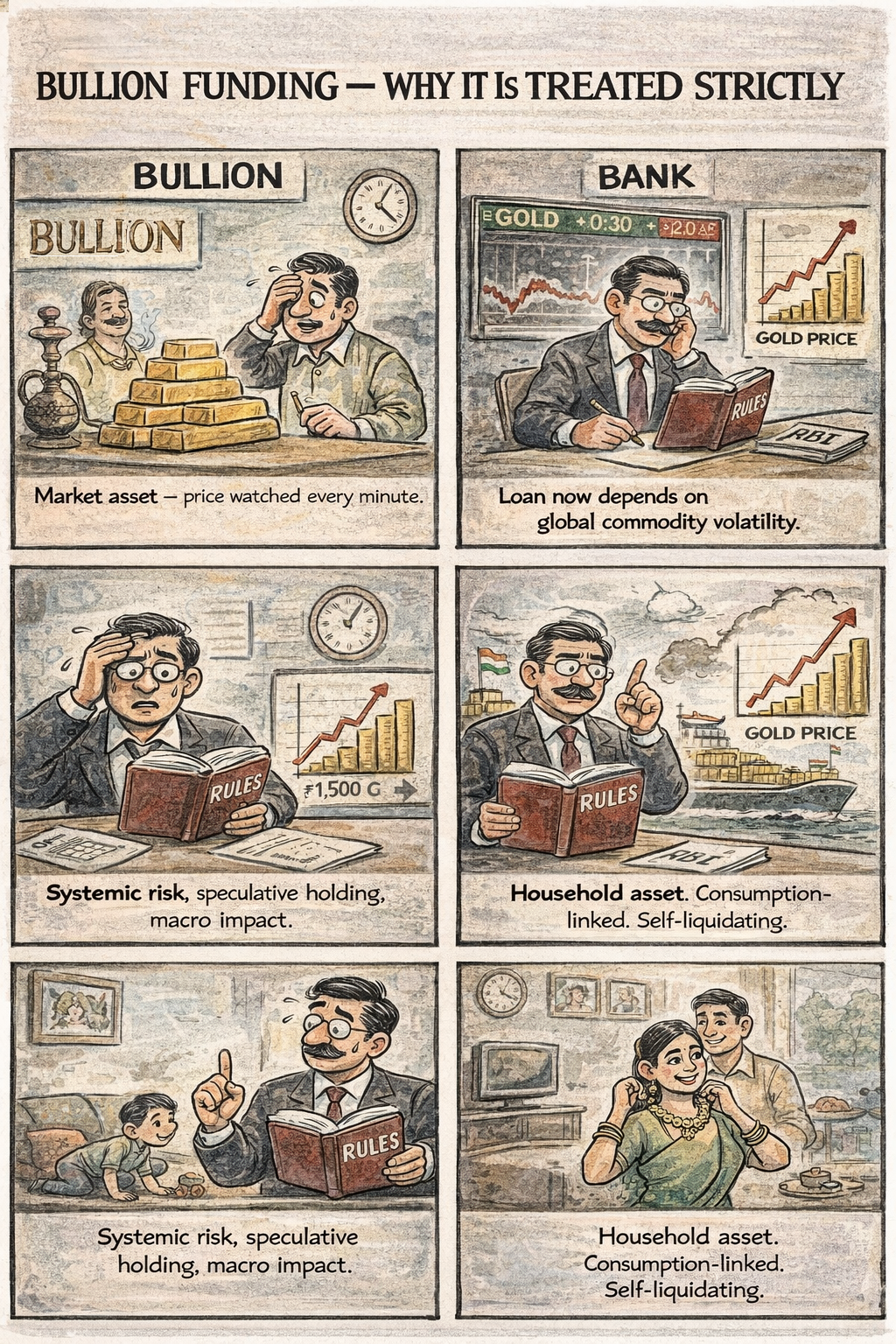
Bullion Funding — Why It Is Treated So Strictly Bullion funding sits in a different risk universe because: It introduces commodity price volatility It enables speculative holding It can distort gold imports and macro stability It weakens the “self-liquidating” nature of retail gold credit This is why RBI consistently distinguishes jewellery (household asset) from bullion (market asset) .
In June 2025, the Reserve Bank of India took the decisive step of prohibiting loans against gold bullion , highlighting that primary metal holdings pose distinct systemic risks compared with household collateral. This was accompanied by a formal clarification that loans on jewellery and coins remain permissible under prudential norms, but bullion financing as such was off-limits. Further tightening came in late 2025 when RBI barred banks and NBFCs from extending credit against gold that had been repledged by intermediaries or pawn brokers, effectively closing a longstanding workaround used in informal networks.
This underlines the regulator’s focus on ensuring that credit attaches to the original owner’s assets rather than being recycled through commodity-linked chains. (Covered in greater detail in Episode 15) 8. What Actually Works — A Safe Design Principle A compliant, defensible separation looks like this: Jeweller decides commercial benefit (discount / bonus) Bank holds customer funds (if any) under deposit rules NBFC / Bank provides credit only where end-use is permitted No entity disguises credit as storage or payment float Clear role separation is the strongest compliance defence. 9.
The Larger Point Gold lending is expanding rapidly — but growth without clarity creates conduct risk . Most disputes, audits, and regulatory pushbacks arise not from bad intent, but from: Product layering Ambiguous responsibility Over-engineering around restrictions Good governance is simpler than clever structuring. Conclusion Gold and jewellery funding is not a regulatory minefield —it only becomes one when intent, custody, credit, and benefit are blurred .
The RBI’s stance is remarkably consistent: Support collateralised household credit Discourage speculative, price-linked, or disguised commodity exposure Understanding that distinction is the difference between scaling safely and inviting scrutiny . Disclaimer This article is intended solely for academic, educational, and policy-discussion purposes . It represents a synthesis of publicly available regulatory circulars, master directions, supervisory communications, and industry practices as understood at the time of writing.
The views expressed herein do not constitute legal advice, regulatory advice, or product guidance , and should not be construed as a recommendation to structure, offer, or market any financial product. Regulatory interpretation and enforcement remain institution-specific and context-dependent , and may vary based on facts, intent, structure, and supervisory stance. Readers are advised to independently refer to relevant RBI circulars, Master Directions, FAQs, and supervisory communications , and to seek appropriate professional or regulatory clarification before implementation.
Any illustrations, analogies, or comic representations are simplified explanatory tools and should not be treated as definitive legal positions.
Archive note
This essay was restored from Vivek Krishnan’s Wix journal. Its original wording and available visuals have been preserved.
This page is now the permanent canonical edition within Vivek Perspective.