


TRYST WITH TRACTOR FRAUDS
- Jun 9, 2025
- 7 min read
Originally written on Jul 21, 2018

There are those moments when it becomes difficult to tolerate broad brushing. This was a formal group of professionals who started talking about exploring RURAL MARKETS and discussions meandered into Tractor Finance and how it was a fraudulent business to get into. “Risky” – I could accept. Yet here was a champ out-casting a product I held close to my heart. I did not respond… My thoughts echoed strong albeit the small exposure / experience that I possess – I blogged !
I would like to be corrected on any perspective presented herein…. It is just a very broad conceptual discussion on another area which happens to be one of my fetishs – FRAUD PATTERNING !
If we have been long enough in Tractor Finance, let’s admit, all of us have done the mad “Chicken Chasing”. Chasing the elusive tractor customer, who borrowed and did not bother to repay our dues.

Many a time, it is this overwhelming experience that makes us broad brush the business as a bad one to get into.
For the sake of clarity let us tabulate the definition of word “Fraud” - wrongful or criminal deception intended to result in financial or personal gain. So it boils down to INTENT. It has been observed that the intent is bad in approximately 2-3% of the instances. In other instances, intent becomes bad due to negligence / service issues of other stake holders.

Based on experiences shared by various financiers, approximately 1/3rd of the portfolio will struggle with a repayment churn. However 10% takes a within month correction course and would constitute stage 5.
So we are talking of approximately 20 – 22% of the portfolio which will go through the above 4 stages. There is a large chunk that gets knocked off at each stage, which differs financier to financier. Yet the Stage 1 is approximately in the banding of 5 - 8%, and Stage Fraud is between 2 – 3 %. This 2 – 3% also includes ab initio intent issues which get discovered at a late stage ( What we call Non-Starters / Quick Mortality Cases )
Are there some caveats ? Can we do nothing about these ? Can we not have some early warning signals ?
Manifestions of Frauds unfortunately cannot be uniform. It is like disguise. We can broadly guess the guises that the fraudster will take and expect to curtail his attempts.
However, we may look a few patterns that would give us perspectives from the shoes of a fraudster.
This certainly demands a little deeper study or looking at the whole experience from different perspectives. Let us look at the patterns in tractor finance from 3 different perspectives :
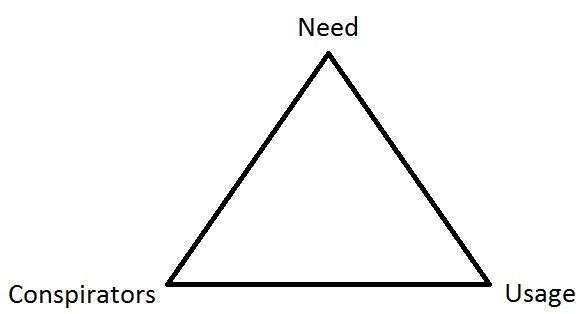
Let’s start with Usage. One of the first definitions that I would like to place in this context is something I frequently quote :
“TRACTOR IS A MOBILE POWER GENERATOR”
So quoting Tractor Mike, if the engine can be disengaged and harnessed separately, the engine power can be used like a generator to generate power. The tractor per se only converts fuel to mechanical energy. This energy is used and harnessed in different ways.
I take cue from the classification uses by Mr. H J Hine, in his research and treatise on tractors and farm equipment.

The usage of a tractor can be through Implements, Haulage (Trailers) or very simply using the engine power of the tractor.
Movement with Load Lifting (Torque) and Haulage (Traction) are accepted uses. However, the belt usage is not considered an economical / correct usage of the tractor and its power.
Hence popular usages such as the ones shown in the videos below and recommended when the tractor is not in good shape and yet the engine is still in good running condition. At this stage, the tractor yields better through secondary usages rather than the primary usage for which it is designed.
Examples of Frauds from USAGE Perspective :
1. Horsepower – Implement Mismatch. When the Implement quoted and the Horsepower of the tractor requested does not match.
2. High Horsepower with no proper justification
3. First Time User where the operation model is not clear, and the usage is also fungible.
4. Where the purchase is based on Dealer Advocacy and not evaluated on work load.
NEED PERSPECTIVE :
Typically the need diagram starts with the customer assessing his requirements well. The key factors in the need cycle are represented below.

Yet what we expect that a customer should undergo is the STEP-UP Method. It is the gradual growing into tractor ownership. Ownership of a tractor because a customer has the means / purchasing power does not ensure its success.
Why ?
The unsaid rule followed in the Rural World, is that each business will have to pay for itself.
Let’s take an example, Customer Tintu Maharaj, has 5 income sources, one of which is his hiring of tractors for agricultural purposes. He purchases a tractor on loan. Shortly thereafter he starts defaulting. The financing bank visits Tintu to find all his other 4 businesses doing well and flourishing. Yet, the tractor business had got into cash cycle issues and Tintu had outstanding receivables due to which he had not paid his dues. While the Bank wanted Tintu to pay his dues, Tintu awaited his receivables to repay his loan. He did not want to offset his returns from other businesses to repay the tractor loan.

THE CONSPIRATORS :
Our Rural Friends / Customers, are the most informed and best connected, in the Tech World. They have been known to make innovative changes in their spheres of work using technology and connections. Yet it is this very connectivity / connections, that has on more than one occasion become the source / conduit / genesis of miscommunication.
If we take up last 7 years data, one can find a new strategy and focus adopted by each manufacturer every year. It almost looks as if the strategy is keep the customer “unsettled”.
If the focus in one year is promoting 50-55 HP, a year or two later it changes to 35-45 HP. In this whole turmoil, irrespective of brand, a tractor customer churns a tractor every 3 - 4 years like a car. The Engineering life of a tractor being 15 years and Financial life being 8 years. In the mad run to fit a scheme around the sales requirements of manufacturers, the repayment culture of the locality gets affected.
A statistical repayment track record for a location therefore needs to be carefully vetted before we arrive at the conclusion that it is indeed a negative location.
For a dealer, “Tractors” is always a PUSH SALES product. Only 45-50% of the dealers genuinely aid the customers gauge his genuine requirement. In most cases, it is fitment of customer requirement to existing stock. The aim will be to justify that the current model in his yard is the best that the customer can get, and they negotiate a deal. Towards this end, he garners support from influencers and middlemen who will influence the customer.
After the purchase, the customer starts facing the problems and thereafter starts his saga…..
The largest contributor to Stage 4 and Stage 3, have been Dealer Credits to Customers.
Dealers issue a Margin Money Receipt for the purpose of documentation / loan. Yet he gives a credit to the customer for repayment. Clubbed along with a loan, the customer struggles and prioritizes the dealers payment over financier payment.
In case there are other service issues, the customer seeks attention of the dealers towards his woes. He stops payment. If unattended, he becomes indifferent. If still unattended, he tries to palm off the asset and make good his losses.

And yet we have another class of our brethren / people from our own companies / our own associates who in the name of transparency and winning the customer, educate the customer of our processes, and what is exactly involved.
This information is communicated to fraudsters who are in the garb of customer’s close aides / friends seeking loans for purchase of tractors.
This starts a chain of information being prepared exactly to fit the requirements of the financiers. The cases of successful disbursements are studied very well both in terms of documentation and process very well.
So where are ? How better are we at managing these ?
1. The “Intent” portion is rarely uncovered. Yet the heartening news is that this is only
2-3% of most portfolios. If skip tracing is adopted, this reduces further to 1 – 1.5 %
2. Effective Credit Mechanism specifically catering to the TRACTOR FINANCE will certainly aid in reducing the extent of fraud instances.
3. A method of Laggard Analytics on Credit Done over 12 - 18 month period will aid in measuring / scaling the quality of Credit.
4. Profiling with Geo and Pin Code Based Mapping will give customized inferences, which will be unique to each financier. Yet this is the best pattern from internal sources that one can get for Tractor Finance.
5. STOP Financial Educators talking about our process. We need to talk about our product. Not our process. Our people unknowingly become conspirators to crimes.
6. Algorithm creation is definitely an option that can be explored. 85% of the logics can be algorithm based. However, some correlations will need to be manual flags.
7. Checking for frauds, if at all, in tractor finance would effective zero in around :
a. Processes around DMA / DSA
b. Processes around Marketing Executives / Agents / Feet on Street
c. Proper Credit Verification
d. Proper FI Verification, with Validations and Verifications
e. Check on Basic Tractor Tenets – Use, Need, Load, Experience, Network
f. Check on how the customer is doing even after disbursement.
g. Check on Dealer Credits and become wary of dealer practices
8. It is also good to know where our customers can be reached. Wild Chicken hunting is a productivity killer and morale dampner. In some cases, it becomes unavoidable and would be ideal if we weave a time frame (how much we spend ) around it.
In Tractor Finance it is as important to know what my customer is undergoing as important it is to increase business.
As much as we fear frauds, 97% of the instances, the checks and balances are with us, and the business will grow if our confidence grows. Our confidence grows if our portfolio performs well over a longer tenure.


Comments