


The Jewellery Lending Architecture — Told as a Story
- Dec 25, 2025
- 3 min read
Jewellery Business Series - Episode 8
Not how loans are sanctioned, but how risk quietly travels.
Act 1: The Customer Walks In
A jeweller walks into a bank branch.
He is profitable. He has customers. He has gold moving every day.
He also has advance money from customers — monthly plans, bookings, rate locks.
On paper, this looks comforting.
“Customer advances reduce working capital,” someone says.
The file moves forward.
The architecture begins here.

Act 2: The First Design Choice — When Is Gold Actually Owned?
This is the first fork in the road.
In some cases, gold is already owned or hedged.
In others, gold will be bought later — funded by exports, schemes, or future cash.
No rule breaks occur. No alarm rings.
But a quiet assumption is made:
Timing will take care of itself.
This assumption becomes a load-bearing wall in the architecture.
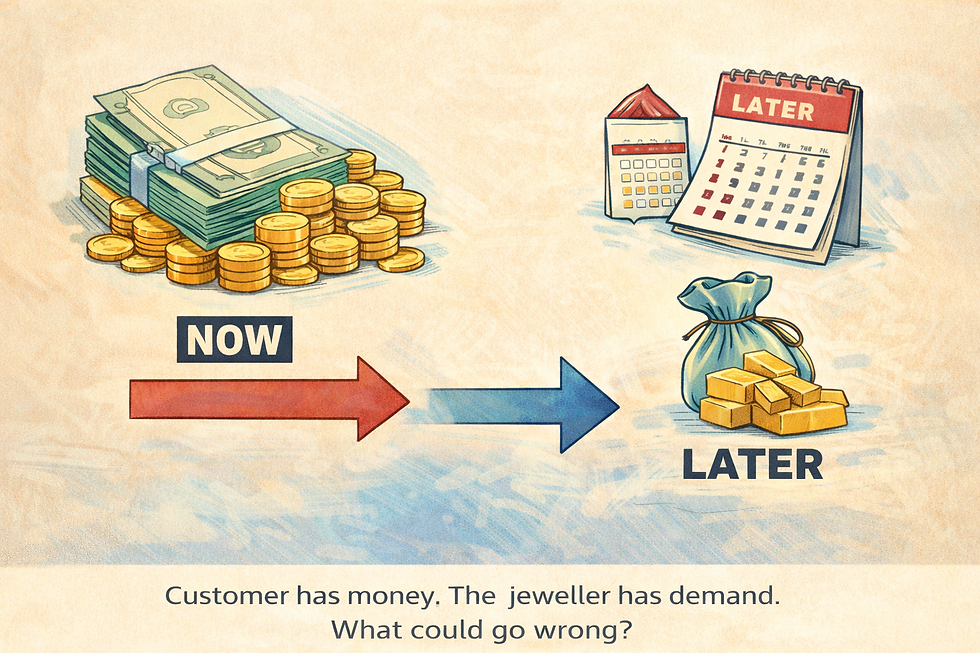
Act 3: The Bridge Is Built (Export-Linked Gold)
To manage timing, a bridge is built.
Export-linked gold. Advance authorisation. Duty-free imports.
Perfectly legal. Perfectly documented.
This bridge allows:
customer promises today
gold procurement tomorrow
The building grows taller.
But the bridge is external. And external bridges carry external risk.

Act 4: The Balance Sheet Looks Strong
Now comes the illusion.
Customer advances sit comfortably
Inventory turns look healthy
Ratios behave
Cash appears sufficient
The architecture passes all inspections.
But one question is never asked:
If this bridge collapses tomorrow, does the building still stand?
This is where architecture diverges from appearance.

Act 5: The Stress Test That Never Happened
No one stress-tests:
blocked liquidity
delayed exports
frozen cash
sudden gold price moves
The architecture is elegant —but it is not earthquake-proof.
This is not negligence. This is design blindness.
Act 6: The Shock
Then one day:
cash is restricted
exports stall
funds are frozen
obligations mature
Nothing illegal happens that day.
But timing stops cooperating.
And the building reveals its flaw.
Act 7: Different Banks, Different Outcomes
Here’s the twist.
The same building design exists everywhere. But the ground beneath it differs.
PSU banks absorb the shock
Old private banks wobble
New private banks freeze
NBFCs contain quickly
Co-ops crack under concentration
The architecture didn’t change.
The foundation did.
The Big Reveal (What JL Architecture Really Is)
Jewellery Lending architecture is not about gold.
It is about:
sequencing
reversibility
shock absorption
In short:
JL architecture is a timing structure disguised as a balance sheet.
Why This Story Matters
Because once you see it this way:
you stop blaming jewellers
you stop chasing fraud narratives
you start asking better questions
Such as:
What is funding today’s promise?
What breaks first if timing slips?
How quickly can this unwind?
Those are architectural questions.
One-Line Takeaway
Jewellery lending doesn’t fail because gold disappears. It fails because time is misbuilt into the structure.
Normal Credit Appraisal vs Timing-Aware Credit Appraisal
(Jewellery Business Lending)
Area | Normal Credit Appraisal Asks | Timing-Aware Credit Appraisal Asks |
Customer Advances | Are advances genuine and supported by scheme documents? | When do these advances convert into gold obligations? |
Gold Inventory | Is inventory adequately valued and insured? | When is the gold actually owned or hedged against customer promises? |
Export Linkages | Are exports eligible under schemes and properly documented? | What happens to liquidity if exports are delayed, disallowed, or frozen? |
Working Capital Gap | Does DP calculation comply with policy norms? | How much of DP depends on future timing assumptions? |
Liquidity Position | Are current ratios and cash balances adequate? | Can liquidity reverse quickly under timing stress? |
Regulatory Exposure | Are there any known compliance issues? | What is the impact on cash flow if funds are blocked tomorrow? |
Risk Assessment | Is the borrower compliant and profitable? | Is the business reversible under timing shock? |
Stress Testing | What if sales fall or margins shrink? | What if timing slips by 30–90 days? |
Comfort Factor | Long relationship, past conduct, collateral cover | Speed of unwind and shock absorption capacity |
Decision Bias | “This has worked so far” | “What breaks first if timing misbehaves?” |
The Fundamental Difference
Normal appraisal assumes time will behave
Timing-aware appraisal assumes time can misbehave
The same jeweller looked safe in one bank and risky in another.Not because the jeweller changed — but because timing was absorbed differently.
Jewellery lending is not about gold. It is about time, structure, and reversibility.


Comments