


Archetypes in Full Bloom: Who Really Does What in the Jewellery Business
- Dec 13, 2025
- 3 min read
Updated: Dec 24, 2025
Jewellery Business Series – Episode 3: Understanding the Jewellery Ecosystem
If Episode 1 followed gold from bar to ornament, and Episode 2 dismantled the myth of the “cash business,” then Episodes 3 and 4 do something even more fundamental: They answer who is actually running what kind of jewellery business.
In jewellery lending, most mistakes don’t arise from valuation, purity, or LTV. They arise from misreading the business model itself.
A jeweller is not just a jeweller. A showroom is not merely a balance sheet. And inventory does not equate to ownership.
This episode lays out the complete archetype map of the jewellery ecosystem, leaving no permutations out.
Why Archetypes Matter (Before We Name Them)
Banks typically classify jewellers by:
Size (small / large)
Geography (urban / rural)
Brand (chain / non-chain)
Jewellers classify themselves by:
What they sell
Where they source
How busy the shop looks
Both approaches miss the real axis of risk.
The true archetype of a jewellery business is determined by just three questions:
Who economically owns the gold?
Who bears price and design risk?
When does cash actually move relative to gold?
Everything else—turnover, margins, churn—flows from this.
ARCHETYPE 1: PURE RETAIL JEWELLER
(Owns inventory. Sells to end customer.)
Core Reality
Gold is purchased upfront.
Jewellery is owned until sale.
Price, design, and liquidity risk sit fully with the jeweller.
This is the archetype most bankers think they are funding.

Sub-archetypes
1A. Classic Walk-in Retailer
Urban or semi-urban showroom. Inventory heavy. Moderate churn.
1B. Festival-Driven Retailer
Sales concentrated around Akshaya Tritiya, weddings, festive seasons. Long idle periods.
1C. Exchange-Dominant Retailer
Old gold inflow is significant. Dual inventory cycles (scrap + finished goods).
1D. Design-Boutique Retailer
High making charges. Slow movement. High obsolescence risk.
1E. Chain Store (Centralised Inventory)
Branches appear asset-light. Risk actually sits at HO.
1F. Rural / Semi-Rural Retailer
Lower making charges. Higher exchange. Sharp seasonal spikes.

Key Banking Insight
This archetype genuinely needs working capital. Stress arises when it is funded as if inventory were instantly liquid.
ARCHETYPE 2: MANUFACTURER–RETAILER
(Makes jewellery and sells it.)
Core Reality
Controls gold and conversion.
Bears manufacturing, labour, and market risk.
Capital is locked the longest here.

Sub-archetypes
2A. Fully In-house Manufacturer
Capex heavy. Better control. Slower scalability.
2B. Cluster-Based Manufacturer
Relies on karigar ecosystems (Thrissur, Coimbatore, Rajkot).
2C. Design-IP Manufacturer
Own designs. Higher margins. High design failure risk.
2D. Volume Manufacturer–Retailer
Thin margins. Fast churn. Price-sensitive.
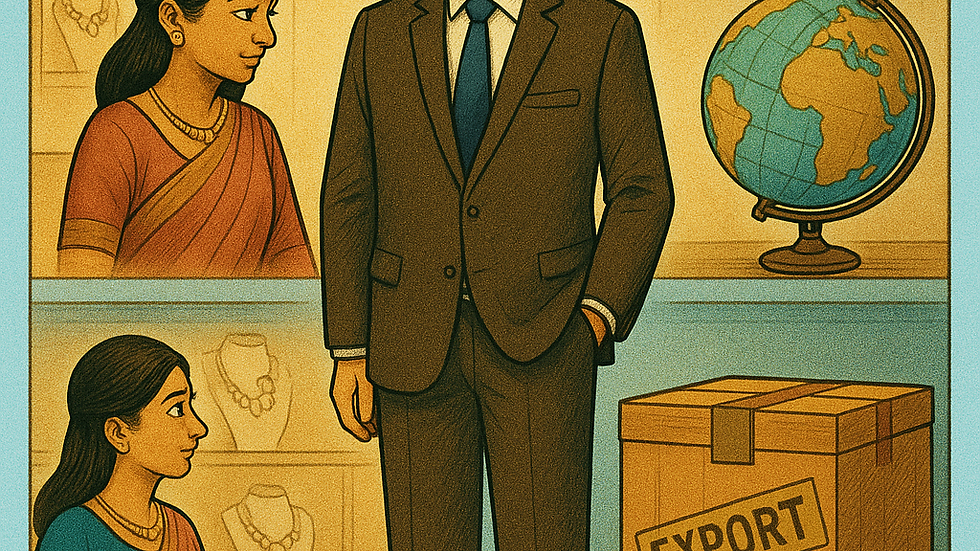
2E. Export-Oriented Manufacturer with Domestic Retail
Dual compliance. Forex + gold price exposure.
Key Banking Insight
Funding must match manufacturing cycle length, not retail appearance.

ARCHETYPE 3: JOB-WORK / CONVERSION PLAYER
(Does not own gold.)
Core Reality
Gold belongs to someone else.
Earns making charges only.
Gold ownership risk is zero.
Sub-archetypes

3A. Pure Job-Worker
Paid per gram or per piece. Minimal working capital need.
3B. Cluster Karigar Unit
Family-run. Informal credit cycles.
3C. Skill-Specialised Job-Worker
Temple jewellery, stone-heavy designs.
3D. Job-Worker with Advance Gold
Temporary custody. High audit sensitivity.
Critical Banking Rule
Never fund gold here. Only fund receivables, tools, or premises—if at all.
Manufacturer vs Job-Worker — The Definitive Distinction Table


Archetype 2 owns business risk and inventory outcomes. Archetype 3 only sells labour and skill, not inventory outcomes.
The distinction between Archetype 2 (Manufacturers) and Archetype 3 (Job-Workers / Karigars) is subtle on the surface, but fundamentally different in risk, capital, and control.
Dimension | Archetype 2: Manufacturer | Archetype 3: Job-Worker / Karigar |
Why Confusion Happens (Especially in India)
In practice, boundaries blur:
Some job-workers temporarily hold gold.
Some manufacturers outsource most work.
Some retailers call job-workers “manufacturers”.
Some manufacturers claim to be job-workers to avoid audits.
But economically, the distinction still holds.
The Banker’s One-Line Test (Use This Always)
Who bears the risk if the jewellery does not sell?
If the answer is “the jeweller / manufacturer” → Archetype 2.
If the answer is “not me, I just make it” → Archetype 3.
No further debate needed.
Why This Distinction Matters (Credit Lens)
If you misclassify Archetype 3 as Archetype 2:
You may wrongly fund gold.
You carry entrustment risk.
You misjudge repayment source.
If you misclassify Archetype 2 as Archetype 3:
You under-fund working capital.
You misread inventory stress.
You mistake structural funding for indiscipline.
So far, we’ve examined three clear archetypes—the retailer who sells, the manufacturer who bears inventory risk, and the job-worker who converts without owning gold.
These three sit at the heart of jewellery creation. But they are not the only players shaping liquidity, risk, and misclassification.
The Next Episode: Exploring Hybrid Models
In the next episode, we turn to the hybrids—distributors, bullion-linked sellers, and models that sit uncomfortably between trade and finance.
We will continue with archetypes in EPISODE 4. ...


Comments