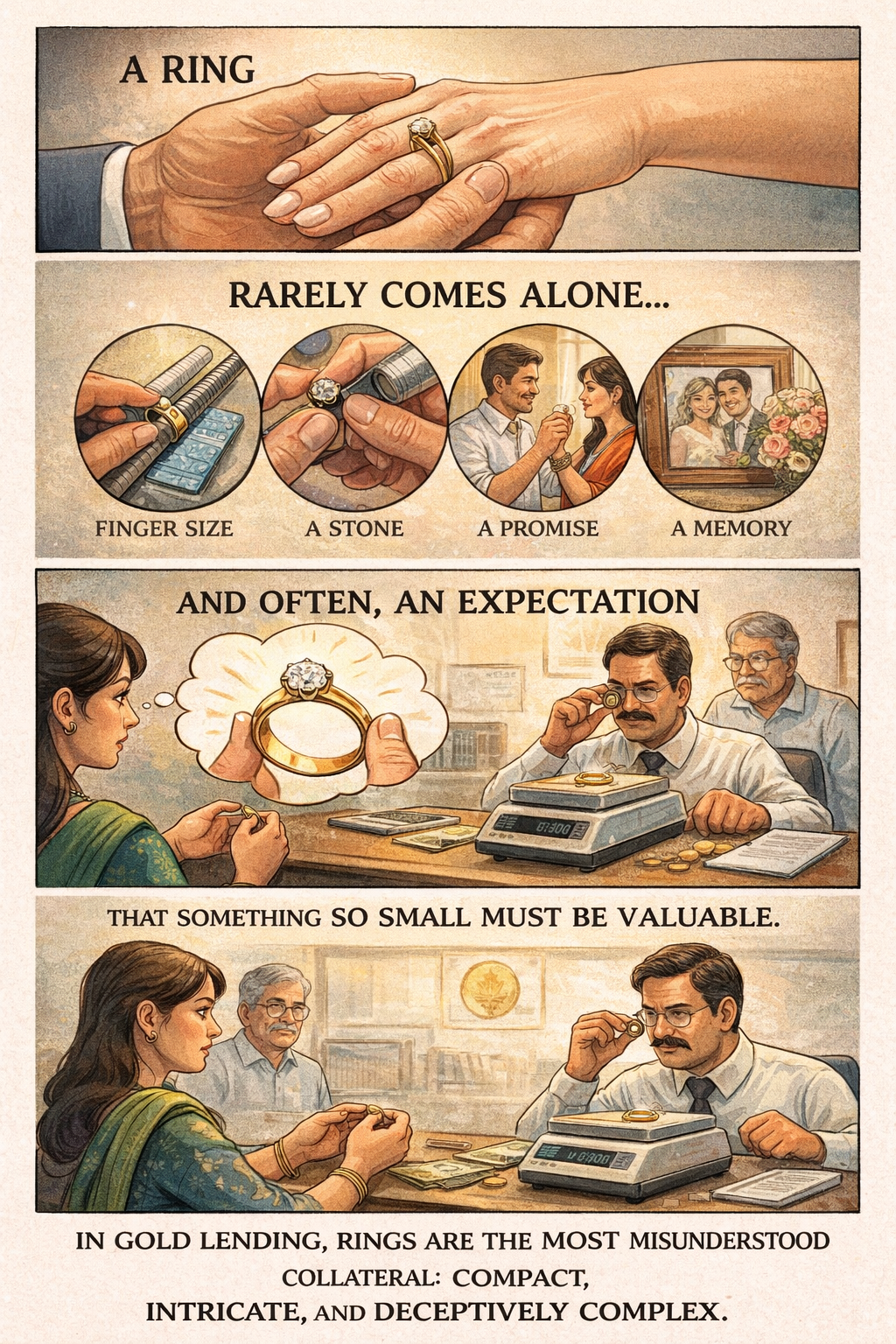
Gold Jewellery Funding : Episode 19 A ring rarely comes alone. It comes with a finger size, a stone, a promise, a memory — and often, an expectation that something so small must be valuable. In gold lending, rings are the most misunderstood collateral: compact, intricate, and deceptively complex. 2. Why Rings Are a Category of Their Own Unlike necklaces or bangles, rings concentrate design complexity into minimal metal mass .
Key distinguishing features: High design-to-gold ratio Frequent use of stones, solder, alloys Precision sizing → cutting and resizing risk Non-uniform recoverability For the banker: rings look efficient In reality: rings are risk-dense objects 3. How Rings Are Made (Structural Intricacies) Typical construction steps: Casting or hand-forging of shank Stone seat creation (bezel / prong / channel) Soldering (often different alloy composition) Polishing, plating, finishing Each step introduces: Non-gold material Micro-voids Alloy inconsistencies 👉 Result: Net gold weight is rarely intuitive 4.
Stone-Set Rings: The Hidden Risk Layer Most pledged rings fall into: Single-stone rings Multi-stone cluster rings Antique or heirloom rings Issues at appraisal: Stones are non-recoverable for lending value Stone weight displaces gold weight Stone settings mask hollowness beneath Borrower expectation: “This ring looks heavy” Banker reality: “Recoverable gold is minimal” 5.
Purity Testing Challenges in Rings Why rings defeat conventional testing: Small surface area → misleading XRF readings Rhodium plating masks base alloy Solder joints distort purity averages Acid/rub tests hit only exposed surfaces Rings are surface-truth objects — not mass-truth objects.
Ring Risk Matrix Ring Construction Element What Happens at the Jewellery Bench Testing Bias Introduced Resulting Credit / Lending Impact Cast shank (mass-produced rings) Alloy mixed upfront; density varies by casting quality XRF averages alloy + micro-porosity Slightly lower purity reading than expected → conservative valuation Hand-forged shank Better grain structure, fewer voids More stable readings Higher confidence in purity; preferred collateral Soldered shank joint Lower-karat solder used for melting control Localised low-purity hotspot Acid/XRF at joint drags down average karat → value haircut Stone seat soldering (bezel/prong) Multiple solder points close together Over-representation of solder zone Purity underestimated → loan eligibility reduction Resized rings Additional solder added post-sale Hidden impurity zones Elevated rejection risk unless melted Channel-set rings Long solder seams beneath stones Surface test misses interior alloy False positives initially → later recovery shock Prong-set rings Tiny solder volume, high surface plating XRF overstates purity Over-lending risk if not cross-checked Stone-studded rings Non-gold mass included Weight illusion vs net gold LTV overstated if stones not deducted accurately Plated rings (gold/rhodium) Surface uniformity hides joins XRF fooled by surface layer Misclassification risk at intake Hollow-back ring designs Metal concentrated on visible face Volume ≠ mass error Expectation mismatch with borrower Mixed-alloy decorative elements Different alloys for colour/strength Inconsistent readings across points Appraisal variance → operational disputes Repair-patched rings Informal soldering by local jewellers Highly inconsistent alloy composition High rejection or melt-only acceptance 6.
Behavioural Pattern Unique to Rings Rings often signal: Emergency liquidity Private stress (rings are personal, not communal jewellery) First-time pledging Reluctance to pledge larger ornaments Typical sequence: Ring pledged first Redemption delayed longer than expected Emotional hesitation to renew Either full redemption or silent lapse Rings rarely indicate planned borrowing. They indicate reluctant borrowing .
Borrower Behaviour Matrix — Rings as Collateral Borrower Action / Pattern Typical Ring Type Pledged Borrower’s Inner Logic Banker’s Interpretation Underlying Borrower Condition Single ring pledged first Plain gold band / small signet “It’s small, easy to get back.” Low-ticket, low-risk loan Short-term cash mismatch Stone ring pledged after removal of stone Engagement / wedding ring “I’ve stripped emotion; now it’s just gold.” Distress escalation Psychological coping under stress Multiple rings pledged together Daily-wear rings “Each ring is minor.”
Fragmented liquidity sourcing Chronic but manageable stress Ring pledged after bangles / chains Sentimental ring “Nothing else left.” Late-stage distress Cash exhaustion Repeated renewal of same ring Plain band “It’s too small to worry about.” Sticky collateral Normalisation of debt Partial redemption attempts Any ring “I’ll reduce interest first.” Behavioural bargaining Optimism bias Resizing before pledge Older ring “I’m fixing it anyway.” Hidden solder risk Liquidity masking Dispute at valuation counter Stone / designed ring “It cost much more.”
Expectation mismatch Value illusion Emotional resistance to auction Wedding / heirloom ring “This cannot be sold.” Recovery sensitivity Identity-linked collateral Ring pledged by younger borrower Modern lightweight ring “This is replaceable.” Consumption-led borrowing Income volatility Non-redemption despite affordability Low-weight ring “Not worth the effort.” Soft default Debt fatigue Last-minute redemption before auction Sentimental ring “I couldn’t let it go.” High emotional leverage Crisis-driven liquidity 7.
Banker vs Borrower Lens Banker sees: Low ticket Quick processing Limited downside Borrower feels: Loss of intimacy Symbolic compromise Temporary surrender with emotional cost If bangles represent continuity, rings represent threshold moments . 8. Operational Reality at the Counter From a process standpoint: Rings slow down appraisal disproportionately Require higher judgement than scales suggest Increase dispute probability on redemption This is why many institutions: Apply conservative LTVs Prefer aggregation with other jewellery Discourage ring-only pledges beyond a threshold 9.
What Rings Ultimately Signal Signal Interpretation Single ring pledged Acute liquidity need Stone-heavy ring Value illusion risk Multiple rings Asset thinning Long tenure Emotional hesitation No top-up Borrowing not habitual 10. Closing Rings are not about weight. They are about intent. And intent, in gold lending, often matters more than gold itself. A ring is not risky because it is small — it is risky because every gram carries a different story.
Archive note
This essay was restored from Vivek Krishnan’s Wix journal. Its original wording and available visuals have been preserved.
This page is now the permanent canonical edition within Vivek Perspective.