Let’s start this with a positive story – a business oppurtunity wise story and then we can correlate it to other scenarios
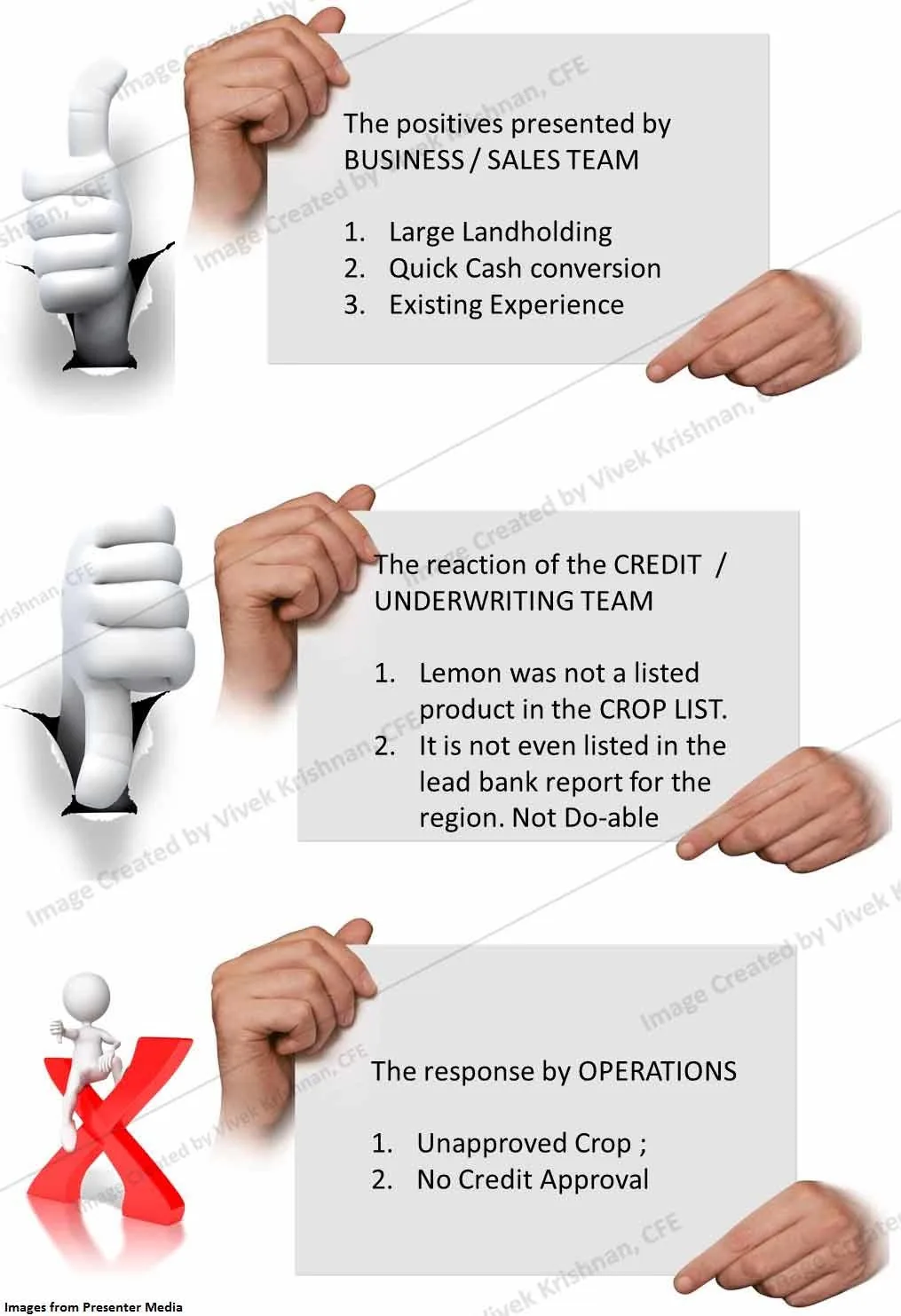
One financier received a case where the customer had quote Lemon to be the crop. The business team had seen a huge oppurtunity… yet the case found its way into the rejection pile !
Let’s see every department’s perspective in this particular case and their comments were:
Now the reality :
1. The farmer used to cultivate Coconuts in his area. He found skilled labour availability extremely difficult. Over a period of time moved to another crop – Mango.
2. Mango – rains were a problem and water requirements were higher for his soil. Clubbed to it the labour cost was high.
3. On advice from local Krishi Kendras – he was a pioneer in cultivating lemon. The fruit would drop to the ground and hence picking and sorting labour costs were easier.
4. He made approximately Rs. 100000/- every 72 hours.
5. He has been doing this for the past 4 years
6. He has alternate sources of business income as well…
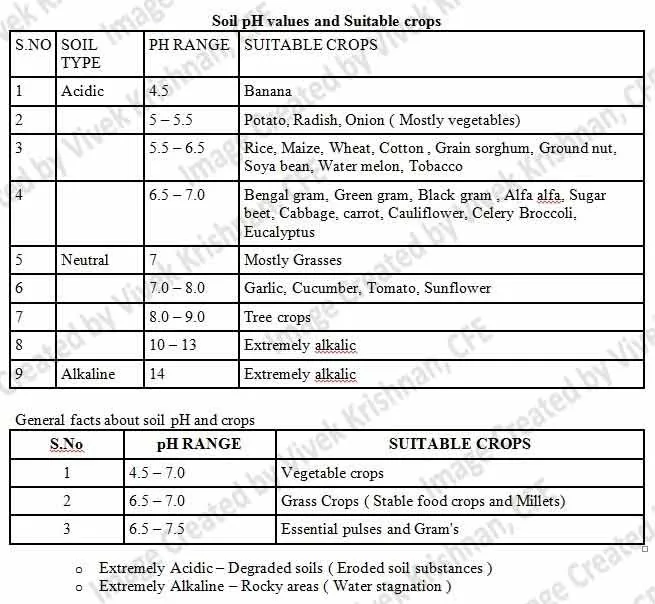
Now, doesn’t that change the whole thing ? None of the departments were able to put it up in this clarity. The simple thing that would have helped credit in understanding is what pH value of soil is required for Lemon Cultivation – 5.5 – 6.5 pH; Coconut has 5.5 – 8.0 ; Mango – 4.5 – 7.0;
So if the customer’s area had a pH value of 5.5 – 6.5, the proposal could have been processed.
One of the first things that I would do whenever I enter a new geography / terrain is to mark its “natural” crops. This would give me an idea of the pH values. An occasional visit to the Krishi Vidyan Kendras will provide very valuable inputs on latest trends and soil concerns. Then I would use the following tabulation to calibarate :
We would probably do well to know more of our geo to be able to judge :
If a crop can be cultivated in a location
(a) Is it popularly cultivated ?
(b) Commercial Viability – in terms of earning and market for the crop
(c) Has the crop been a recent cultivation pattern ? Is it seasonal ?
(d) Water and Soil requirements Assessment.
If a crop cannot be cultivated due to inherent pH values of the soil, yet is being cultivated
(a) Is there a commercial pressure to cultivate the crop in question.
(b) Suitability of the crop – Average yield of the Crop
(c) Cost of Cultivation and Profitability / Income per Acre
This is the understanding we all need to have. Farm Equipment Finance is not tough. It seems tough because we do not take cognizance of the factors impinging on a decision to take finance. We are not aware of the life of a farmer.
It would not be off mark to that Tractors occupy only 10-15% of the farmer’s requirement. Assess the holistic picture.
The one who identifies the customer and his gamut of requirements, and understand the customer’s priorities well, WINS.. ! If you are out at the number game here – halleluiah!
It needs you to spend time and know this territory and domain as well your Fingerprint type. So those uniniatiated, there are broadly 9 fingerprint types. So which type do you fit into ? Similarly define your REGIONS based on your domain and territory knowledge and you’d be surprised at the way frauds come down.
The farmers do not require waivers. In the absence of better mechanisms of income governance, they seek waivers…. Don’t believe me – here’s proof :
https://www.youtube.com/watch?v=3w-oZdEzotQ&feature=youtu.beComing back to the topic - " Fraud Prevention in Farm Equipment Financing " – I would say, much of it is in how we manage. No Trigger / identification pattern can last forever, yet your domain and logical rationale is your best defence… !
THANK YOU...
Archive note
This essay was restored from Vivek Krishnan’s LinkedIn archive. Its original wording and available visuals have been preserved.
This page is now the permanent canonical edition within Vivek Perspective.