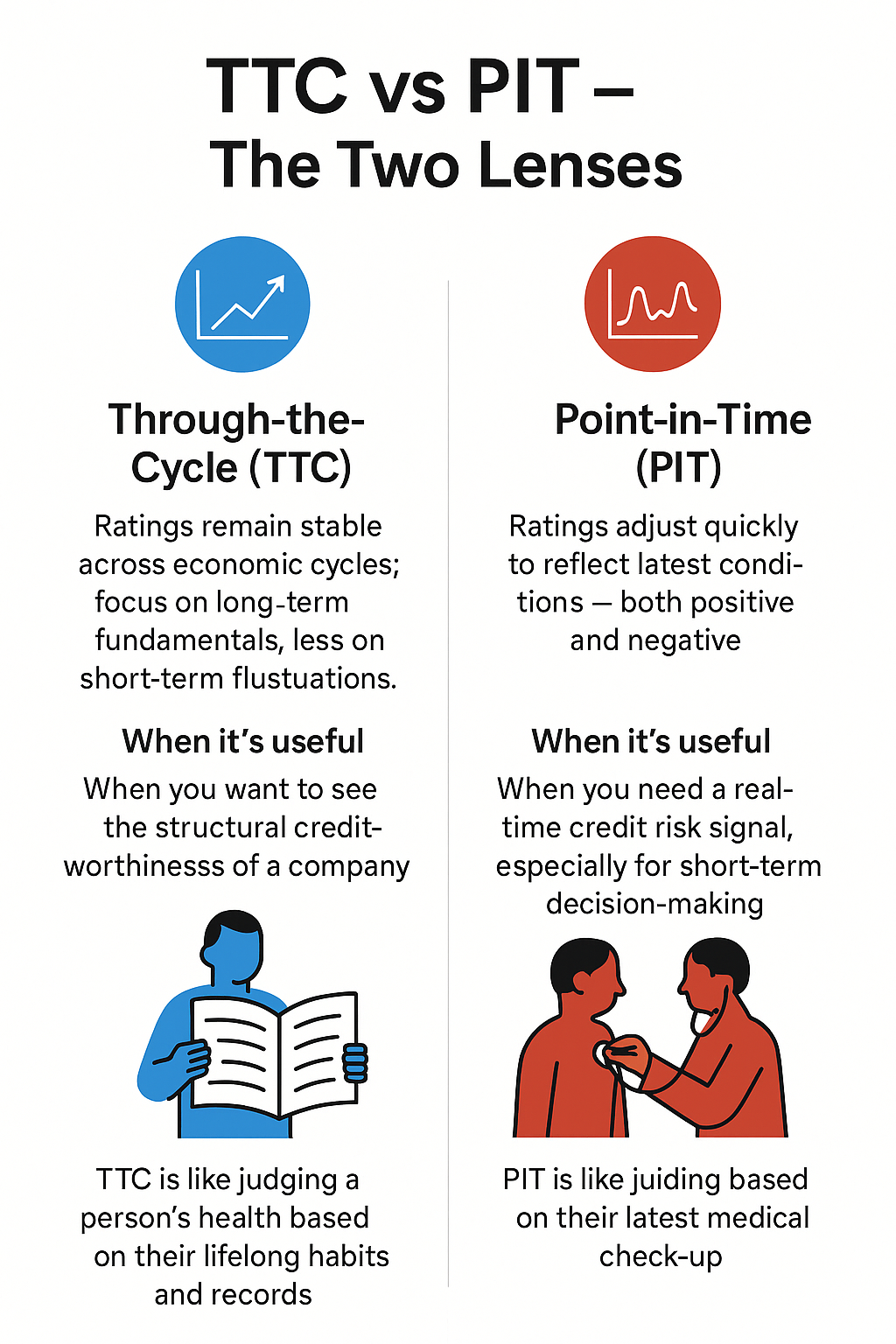
Policy Vs Practice The Setting (Rating Methodologies) A branch credit officer is reviewing a ₹50 crore working capital renewal for a reputed engineering firm. The borrower proudly points to their BBB rating from a leading agency. Looks decent. Case closed? Not so fast. RATING METHODOLOGIES TTC vs PIT – The Two Lenses Approach What It Means When It’s Useful Through the Cycle (TTC) Ratings remain stable across economic cycles; focus on long-term fundamentals, less on short-term fluctuations.
When you want to see the structural creditworthiness of a company. Point in Time (PIT) Ratings adjust quickly to reflect latest conditions — both positive and negative. When you need a real-time credit risk signal, especially for short-term decision-making. TTC is like judging a person’s health based on their lifelong habits and records. PIT is like judging based on their latest medical check-up. Policy vs Practice Gap Policy: Regulators prefer TTC for capital adequacy to avoid systemic shocks, but expect PIT-like monitoring for risk recognition.
Practice: Borrowers quote whichever rating is most flattering; lenders often don’t verify methodology, especially at branch/business level. Why This Matters in Credit Underwriting A TTC BBB could mean today’s risk is closer to BB (if industry is in a slump). A PIT BBB could mask long-term cyclicality risks if the current quarter is strong. Practical Steps for Credit Officers Ask the agency methodology — TTC or PIT. Overlay internal scoring to capture current risk movement. Adjust covenants or pricing if methodology skews the risk picture.
Read the press release of the rating — the clues to methodology are often hidden in the fine print. If you hear: “Our ratings are stable and predictable.” → This is usually TTC-leaning — appealing to corporates who want funding lines to remain intact even in industry downturns. Stability sells to CFOs managing long-term projects. “Our ratings reflect your current market position.” → This is usually PIT-leaning — attractive to companies currently performing well, looking for quick upgrades, or planning a fundraise. “We balance market realities with long-term fundamentals.”
→ Often a hybrid approach — sounds reassuring but can mask that the methodology may still lean more one way than the other. “We avoid sudden downgrades unless absolutely necessary.” → Strong TTC signal — good for optics, not necessarily for real-time risk detection. “Our process is data-driven and forward-looking.” → Usually PIT-oriented — means the rating is sensitive to the latest data, and can swing up or down quickly. 🔵 Blue Line – Through-the-Cycle (TTC) rating trend, 🔴 Red Line – Point-in-Time (PIT) rating trend Essentially — Blue = stable but slower to react and Red = reactive but more volatile .
Graph Interpretation : 🔵 Blue Line – Through-the-Cycle (TTC) rating trend Stays relatively stable over time. Smooths out temporary economic booms or busts. Less sensitive to immediate market volatility. Reflects average performance across a full business cycle. 🔴 Red Line – Point-in-Time (PIT) rating trend Moves up and down more sharply in sync with current financial performance and market conditions. Picks up rapid deterioration or improvement. More volatile, but more responsive to short-term risk changes.
Ratings Decoder Long-Term Ratings – TTC Backbone (Domestic Agencies) Rating Meaning Default Risk (1-year) TTC/PIT Alignment AAA Highest safety <0. 1% TTC AA+, AA, AA- Very high safety 0. 1–0. 5% TTC A+, A, A- High safety 0. 5–2% TTC BBB+, BBB, BBB- Moderate safety 2–5% TTC BB+ & below Speculative / high risk >5% TTC/PIT mix Short-Term Ratings – PIT Pulse (Domestic Agencies) Rating Meaning Default Probability PIT Alignment A1+ Strongest liquidity 0. 01–0. 05% PIT A1 Very strong liquidity 0. 05–0. 10% PIT A2 Strong liquidity 0. 10–0. 25% PIT A3 Adequate liquidity 0. 25–0. 50% PIT A4 Risk-prone liquidity 0. 50–1.
00%+ PIT D Default 100% PIT International Mapping (Global → Indian) Global Indian Approx.
Meaning AAA AAA Prime credit AA+, AA AA+, AA High grade A+, A A+, A Upper medium grade BBB+, BBB BBB+, BBB Investment grade floor BB+ & below BB+ & below Speculative grade Our 9-Company TTC/PIT Snapshot Company Sector TTC Rating (Long-Term) PIT Rating (Short-Term) Likely Orientation Tata Steel Steel AA- / Stable A1+ TTC heavy Infosys IT AAA / Stable A1+ TTC stable sector Adani Enterprises Trading AA- / Stable A1+ TTC/PIT mix Wipro IT A- / Affirmed — TTC HDFC Bank Banking AAA / Stable A1+ TTC Bajaj Finance Finance AAA / Stable A1+ TTC/PIT mix SBI Life Insurance Insurance AAA / Stable A1+ TTC Reliance Industries Oil & Gas AAA / Stable A1+ TTC Apollo Hospitals Healthcare AA / Stable A1+ TTC/PIT mix Practical Steps for Credit Officers Ask the agency methodology — TTC or PIT.
Overlay internal scoring to track current risk movement. Adjust covenants/pricing if methodology skews perception. Read the press release — methodology clues are in the fine print.
Aspect PIT Advantage PIT Disadvantage Risk detection Picks up early distress signals Can overreact to temporary blips Capital allocation Closer match between risk and capital Volatility → more procyclicality (tightens credit in downturns, loosens too much in booms) Pricing Enables risk-based pricing changes faster May alienate good customers during temporary dips Portfolio stability Keeps you agile Makes portfolio look unstable in stress tests Why some lenders still prefer TTC (Through-the-Cycle) for sanctioning TTC avoids whiplash lending — sudden pullback or expansion purely due to short-term swings.
Regulators and rating agencies often like TTC for capital adequacy calculations because it reduces procyclical shocks. From a clarity standpoint: For the lender: PIT gives a sharper present-day risk picture but can be procyclical — meaning it may force provision hikes or curtail lending during downturns, even to fundamentally sound borrowers. TTC smooths the ride but can mask rapid deterioration until it’s too late.
For the regulator (RBI): They generally lean towards TTC for capital adequacy purposes, because it avoids systemic shocks. But in operational risk assessment, they expect lenders to have PIT-like granularity to catch trouble early. For the borrower: TTC ratings keep funding lines open during bad times, so they lobby for it. PIT may work in their favour if they’ve recently improved performance and want the rating upgraded quickly.
The “right” thing is situational : Long-tenor infra / project finance → TTC bias. Short-tenor WC / MSME lines → PIT bias. Mixed portfolios → hybrid models (regulatory capital on TTC, internal monitoring on PIT). THE DECISION IMPACT Here’s what research and case data show: 1. Impact on Default Prediction Accuracy Empirical finding (Basel Committee, 2005; Moody’s Analytics, 2010) : PIT ratings tend to downgrade faster before defaults, giving earlier warning. TTC ratings lag by 6–18 months , meaning a lender could be exposed to a deteriorating borrower without realizing the risk.
Impact: In a downturn, TTC-rated portfolios can see sudden spikes in NPA recognition because deterioration is recognized late. 2. Credit Growth Cyclicality IMF Working Paper (2014) : Countries/lenders leaning on PIT ratings showed procyclical lending patterns — tightening credit more sharply during downturns, which worsened the slowdown. TTC-heavy systems maintained lending volumes longer, but suffered more capital shocks when the reality finally caught up. 3. Indian Corporate Defaults – IL&FS & DHFL Both carried investment-grade TTC-style ratings until weeks/months before default.
PIT-style shadow risk models (some banks’ internal scores) had flagged deterioration 6–9 months earlier , but weren’t acted on because regulatory capital norms still relied on external TTC ratings. 4. Capital Adequacy & Provisioning Impact RBI’s capital rules allow lower risk weights for higher-rated borrowers. If a rating remains artificially high (TTC lag), banks hold less capital than required for actual risk .
This directly affects systemic stability — a key Basel II/III concern. ✅ The takeaway: PIT is better for forward-looking risk control at the loan origination & monitoring stage. TTC is better for long-term portfolio capital stability but can create blind spots. The policy–practice gap emerges because capital norms reward TTC stability, while actual credit safety often needs PIT reactivity.
Why It Matters A rating without methodology context is like a blood pressure reading without knowing if it’s taken at rest or post-run. Policy says “Be stable” , Practice demands “Be real-time” —The art lies in balancing both.
Archive note
This essay was restored from Vivek Krishnan’s Wix journal. Its original wording and available visuals have been preserved.
This page is now the permanent canonical edition within Vivek Perspective.