If there is one question that keeps surfacing in customer onboarding counters across India, it is this:
“My Aadhaar has an initial, but my PAN and Passport have my full name.
Can the bank force me to open the account as per Aadhaar?”
Short answer: No.
Long answer: Absolutely not — and RBI rules are clear about this.
Yet, this confusion persists in branches, audits, and even among frontline staff. This blog breaks down the regulatory truth, the operational reality, and what customers can do when faced with this insistence.
1. What the RBI Actually Says About Name & KYC (Aadhaar vs PAN/Passport)
The RBI’s Master Direction on KYC (2016, updated regularly) lays down a simple principle:
👉 A customer may submit any one Officially Valid Document (OVD) for KYC.👉 Aadhaar is only one of several OVDs.
The complete list of OVDs includes:
Passport
PAN
Voter ID
Driving Licence
NREGA Job Card
Aadhaar
There is no RBI instruction that Aadhaar must be the primary or default document.
Meaning: If you choose to use your Passport/PAN, the bank must accept it.
2. Name Variations Are Allowed — RBI Says So
Across India, names appear differently across documents:
Initials vs expanded names
Short forms vs full forms
Father’s name included or excluded
Order of names (South vs North style)
RBI recognises this lived reality.
The KYC Master Direction specifically permits “minor variations in name… provided the identity of the customer is established.”
If your PAN, Passport, photo and signature clearly establish your identity, a slightly different Aadhaar name cannot be used to deny or alter your account name.
3. Aadhaar Is Optional — Not Compulsory — for Bank Accounts
This is the part most misunderstood.
UIDAI and RBI have repeatedly clarified that:
✔ Aadhaar is not mandatory for opening a bank account✔ e-KYC is optional✔ The customer can choose which OVD to use
If you provide a Passport as the OVD, Aadhaar is not required at all — not for name, not for address, not for seeding.
4. So Why Do Banks Sometimes Insist on Aadhaar Name?
Three practical reasons — none of which are regulatory:
a) e-KYC automation
If the branch uses Aadhaar e-KYC, the CBS auto-populates the Aadhaar name.Staff then assume that the Aadhaar name must be used — which is incorrect.
b) Internal audits pushing Aadhaar seeding
Some audits push for Aadhaar seeding for operational convenience — again, not an RBI mandate.
c) Staff unfamiliarity with the full OVD rules
Frontline teams tend to default to Aadhaar because it is the most commonly used ID.But RBI compliance lies in accepting any OVD, not forcing a specific one.
5. The Most Common Scenario: Initial vs Full Name
Let’s take a real-life, daily example:
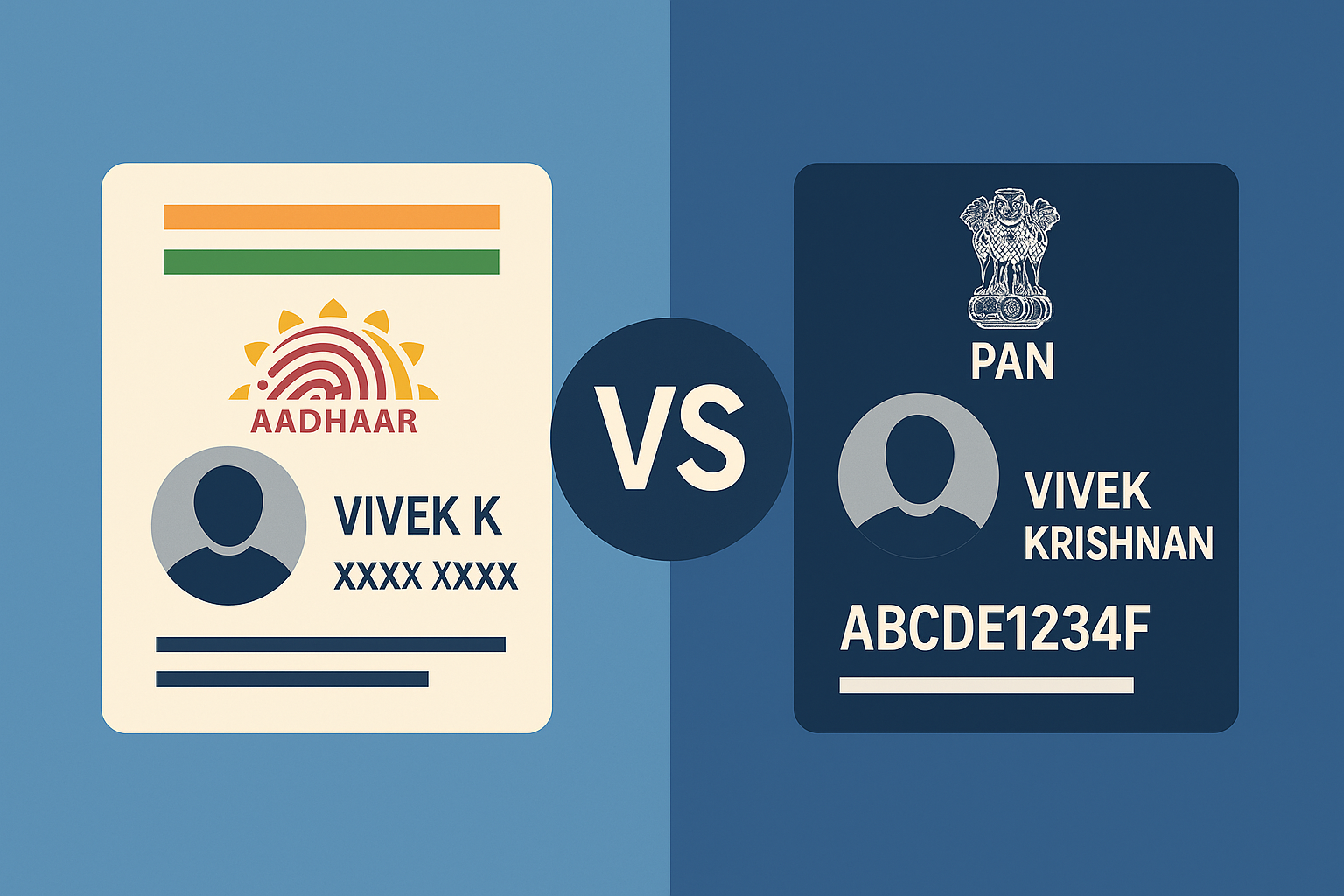
Aadhaar Name: Vivek K
PAN & Passport Name: Vivek Krishnan
Should the bank force “Vivek K” on the account?
No.
Why?
PAN and Passport reflect full name
Your identity is clearly established
Initials vs expanded name is considered a minor variation
Customer’s chosen OVD determines the account name
The account can — and should — be opened as Vivek Krishnan.
Aadhaar can remain just a supporting document or be skipped altogether.
6. What Customers Can Politely Tell the Bank
A simple, non-confrontational statement works best:
“RBI’s KYC Master Direction allows me to use any Officially Valid Document. I am submitting my Passport and PAN, which reflect my full name. RBI also permits minor name variations across documents. Kindly open the account in the name as per Passport/PAN.”
If needed, you may add:
“Aadhaar is not a mandatory OVD unless I choose to submit it.”
No branch can dispute this — it is pure RBI policy.
7. Why This Matters: KYC Should Not Redefine Identity
Identity should flow from the person, not from one document.
In a diverse country like India:
People carry legacy names
Some prefer initials
Some expand names in passports for international travel
Some documents get updated, others don’t
A single document (Aadhaar) cannot override all others.
Banks must respect the customer’s chosen identity as long as it is supported by any valid OVD — and the RBI framework is built exactly on this principle.
8. Final Word
The next time someone at a bank counter insists:
“Sir, your account name must match Aadhaar.”
Remember — this is not a regulatory requirement. It is a misconception.
Your identity is defined by you, and validated through any OVD you choose — not by the default setting in an Aadhaar e-KYC screen.
And as long as your identity is clearly established, your preferred name — as per Passport/PAN — must be honoured.
Archive note
This essay was restored from Vivek Krishnan’s Wix journal. Its original wording and available visuals have been preserved.
This page is now the permanent canonical edition within Vivek Perspective.